Unit 1: Foundations of Longevity Coaching
Chapter 1.6: The Longevity Coaching Process
[CHONK: 1-minute summary]
What you'll learn in this chapter:
- How to apply PN's 6-step coaching model to longevity clients, step by step
- Why longevity coaching asks you to think in decades, not just weeks
- How to onboard new clients with a simple, phased 3-month plan that builds momentum
- How to map out multi-year roadmaps and build systems clients can stick with long-term
The big idea: Longevity coaching isn't a 12-week transformation. It's a decades-long partnership where you help clients build systems, not just habits. PN's 6-step coaching process fits longevity well, with a few key adaptations for long-term thinking, biomarker tracking, and whole-person health. In this chapter, you'll learn how to use the iterative coaching cycle to support sustainable behavior change over years, not months, without trying to do everything at once.
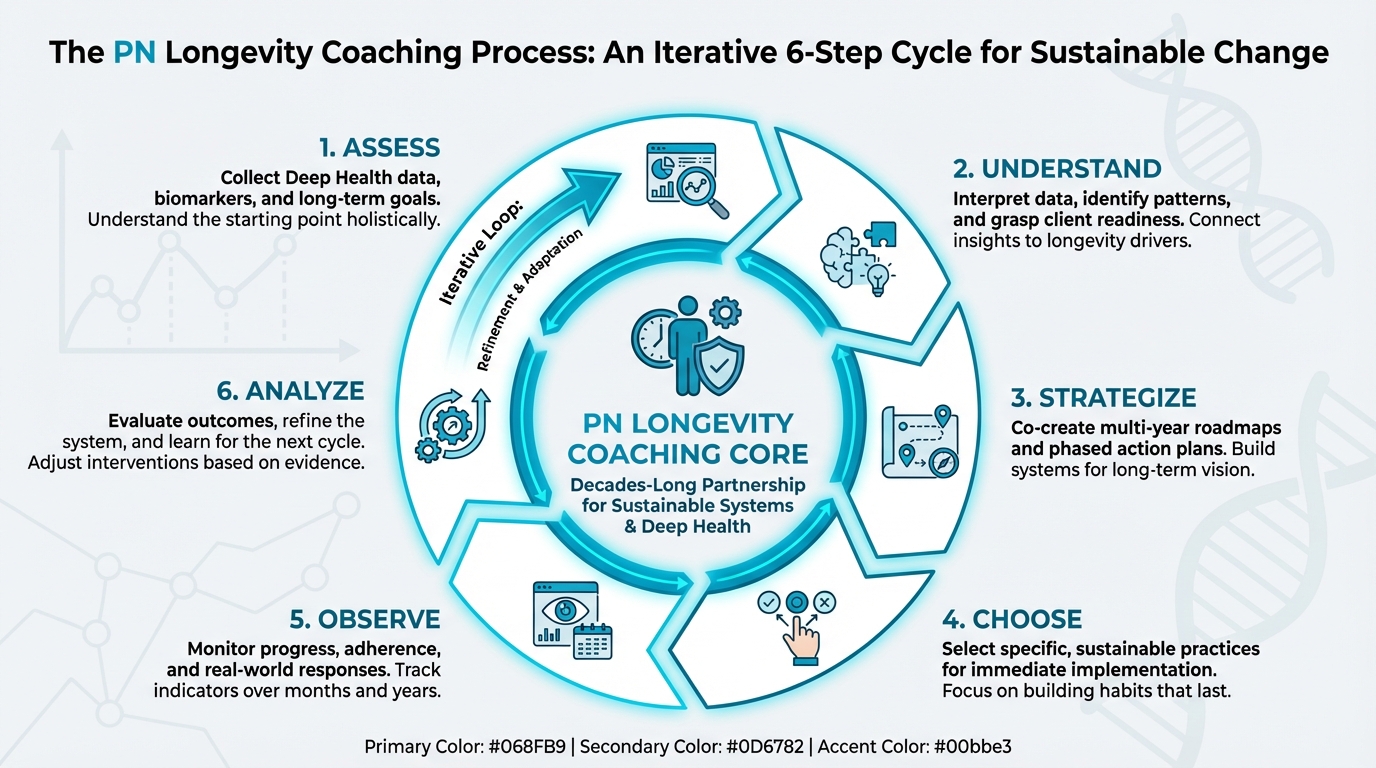
Figure: Iterative process visualization
Introduction
You've learned what longevity coaching is, how aging works at the biological level, and how Deep Health applies to longevity. This chapter turns that into a coaching practice you can use with real clients, in real life, for the long haul.
Longevity coaching is fundamentally different from most other types of coaching because you’re playing a much longer game. Rather than aiming for a 12-week transformation or a 90-day challenge, you’re helping clients make changes that last for years (even decades) by building systems, not just habits, and planning for the long haul while still making meaningful progress today.
That longer time horizon changes the day-to-day coaching conversation too. For example:
What not to do
Client: “Can you just tell me what to do for the next 12 weeks so I can see results?”
Coach: “Sure. Here’s the full plan.”
A better approach
Client: “Can you just tell me what to do for the next 12 weeks so I can see results?”
Coach: “We can absolutely build momentum in the next 12 weeks. At the same time, I’d like to set this up so the changes still work for you a year from now. Would you be open to a simple first phase that we can adjust as we go?”
If that sounds like a lot of responsibility, you’re not alone. It’s also what makes this work rewarding, and you don’t have to have it all figured out on day one.
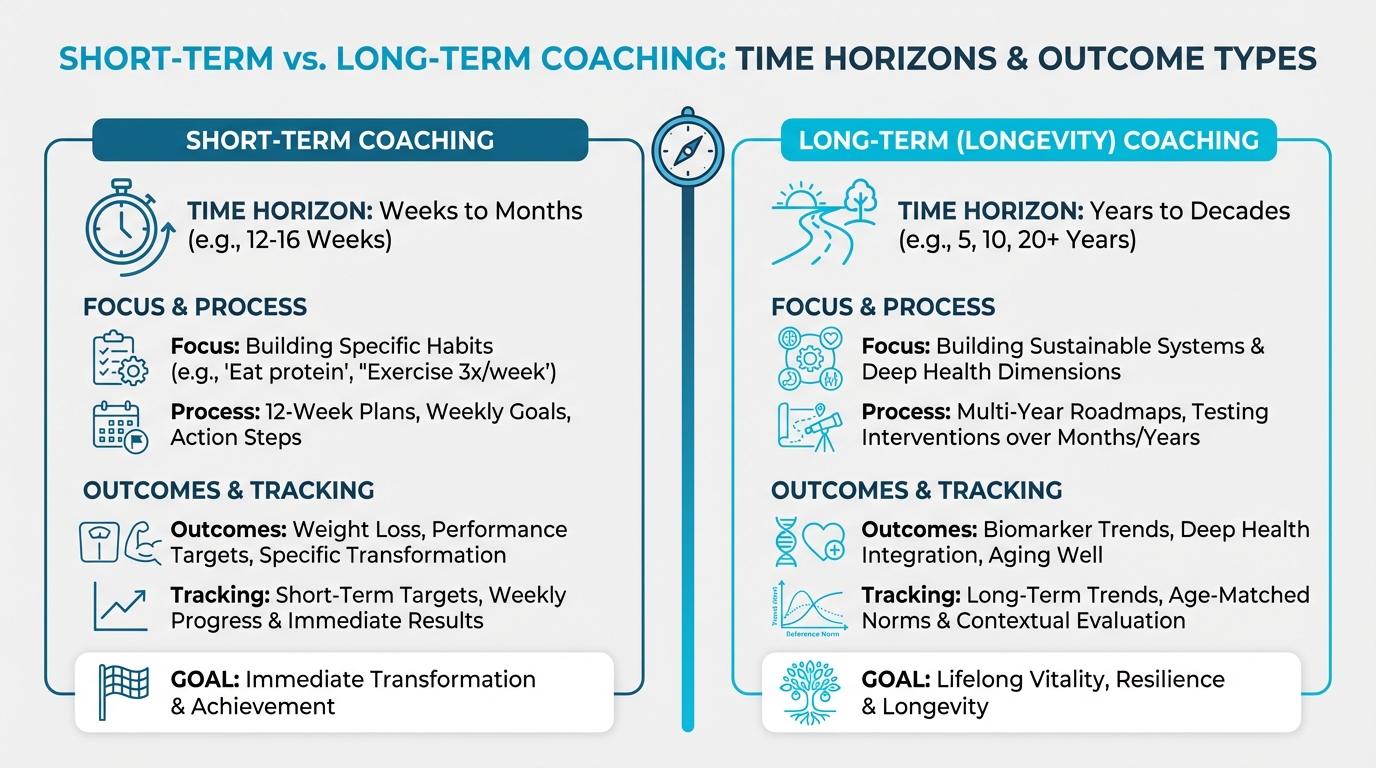
Figure: Time horizons and outcome types
In this chapter, we'll show you how to apply Precision Nutrition's 6-step coaching model specifically to longevity coaching. You'll learn how each step adapts when you're thinking in decades instead of weeks, how to implement a phased onboarding strategy that builds sustainable change gradually, and how to create multi-year roadmaps that help clients stay on track for the long haul. If that pace feels unfamiliar, you’re not behind; you’re just zoomed out.
What Makes Longevity Coaching Different
Longevity coaching has a few features that make it unique. Here are the big ones:
Time horizon: You're planning for decades, not weeks or months. A 52-year-old client isn't just working toward next quarter; they're building toward their 60s, 70s, and beyond.
Metrics: You're tracking biomarkers, biological age, and functional capacity, not just weight or performance. Some of these metrics change slowly, but slow change doesn’t mean “no change.”
Goal-setting: You're creating multi-year roadmaps with short-term milestones along the way, so the big picture provides direction while the milestones keep motivation high. Think of it like a map plus mile markers.
Sustainability: You're building systems and environments that last years, not quick fixes that fade. A habit is good; a system that makes the habit inevitable is better.
Integration: You're considering all six Deep Health dimensions at every step, not just physical health. Longevity isn't just about living longer; it's about thriving across every dimension of life.
Because of those differences, you’ll make some adjustments to the coaching process. The 6-step model still works: it's the same iterative cycle of assess, understand, strategize, choose, observe, and analyze. But how you apply each step changes when you're coaching for longevity.
Up next is the process itself.
[CHONK: The PN 6-Step Coaching Process]
The PN 6-Step Coaching Process: Applied to Longevity
The PN 6-step coaching process is a systematic, iterative approach you can use to support behavior change. It’s built on a simple idea: coaching is guiding change, and change tends to happen in cycles of assessment, understanding, planning, testing, monitoring, and evaluation. You don’t need a perfect plan, just a workable loop.
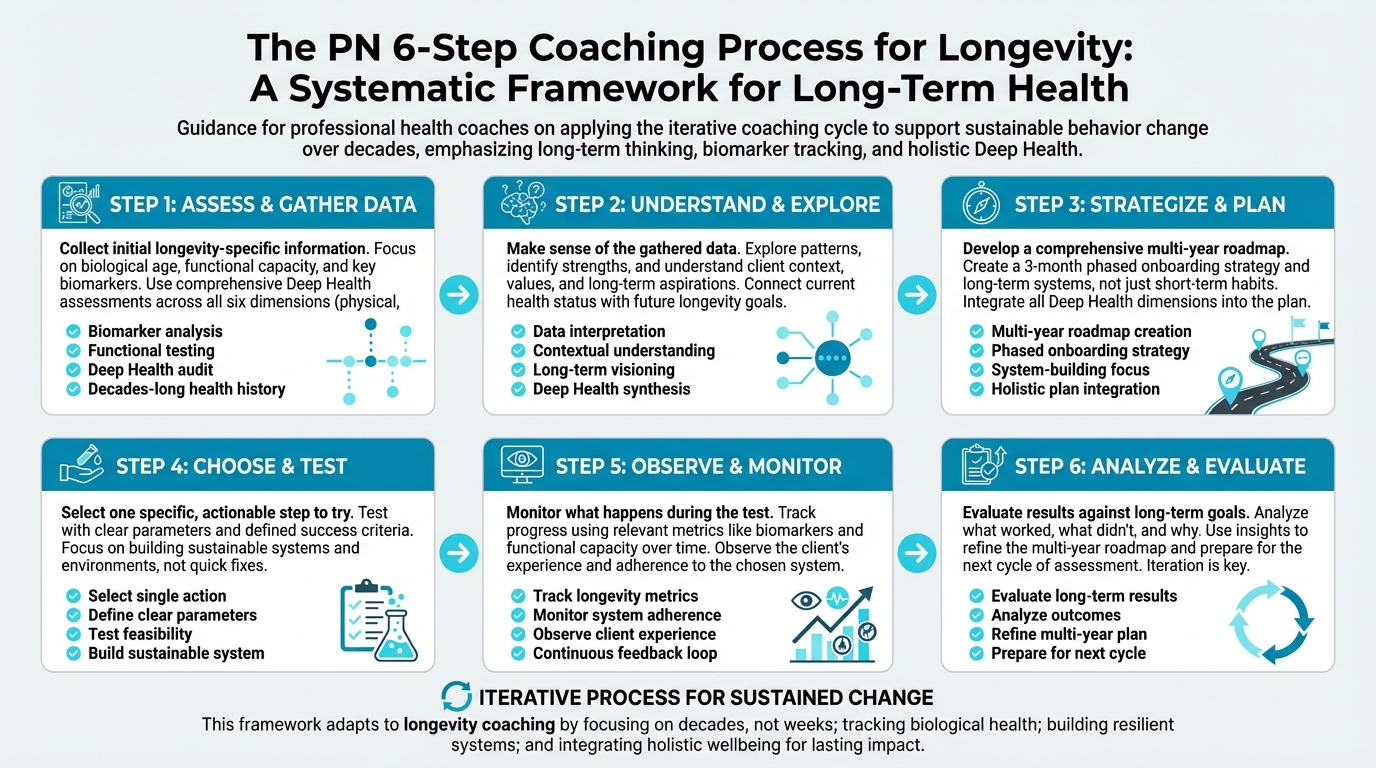
Figure: What happens at each step
Here’s the quick overview:
| Step | What It Is | The Longevity Adaptation |
|---|---|---|
| 1. Assess | Gather data, establish baseline | Full longevity assessment across all six Deep Health dimensions |
| 2. Understand | Explore who the client is | Their story about aging, values, purpose, long-term vision |
| 3. Strategize | Create a plan | Multi-year roadmaps with phased implementation |
| 4. Choose | Select and test one action | Evidence-based, client-centered interventions |
| 5. Observe | Monitor what happens | Long-term tracking of biomarkers and all dimensions |
| 6. Analyze | Evaluate and decide next steps | Sustainability checks, roadmap adjustments |
Because this process is cyclical, you don’t do each step once and move on. Instead, you keep looping through the steps, learning and adapting as you go, with Step 6 leading right back to Step 1. Once you analyze what happened, you assess again, understand more, strategize smarter, and keep improving.
This cycle repeats throughout your entire coaching relationship. In a single session, you might touch all six steps, and over months and years, each full cycle teaches you more about what works for this specific client. That steady loop is the engine of continuous improvement, and it’s a big part of what makes longevity coaching effective over decades. It’s a big commitment, and it’s also why this work can be so meaningful.
Step 1: Assess and Gather Data
Assessment is where everything begins, and in longevity coaching it’s usually more thorough than what you’re used to, because you’re collecting data about where your client is now and building a baseline that can guide your work together for years. It’s a lot, and you don’t have to gather everything on Day 1.
If you’ve coached for weight loss or performance, you probably assessed weight, body composition, exercise history, and nutrition habits. All of that still matters for longevity. Longevity coaching just adds a few more layers:
Longevity-specific biomarkers:
- VO2 max (the strongest mortality predictor, target: 35+ mL/kg/min)
- Grip strength (proxy for overall muscle function. Target: 70+ lbs)
- Functional tests (sit-to-rise, balance, gait speed)
- Bloodwork (inflammatory markers, metabolic markers, lipids)
- DEXA scans (bone density, body composition, visceral fat)
All six Deep Health dimensions:
- Physical: biomarkers, function, energy, sleep, pain
- Emotional: stress, mood, resilience, emotion regulation
- Mental: cognitive function, memory, focus, mindset about aging
- Social: relationship quality, support, community, loneliness
- Environmental: access to resources, safety, living situation
- Existential: purpose, meaning, values, "why" for longevity
Longevity-specific history:
- Family history of age-related diseases
- Previous longevity interventions (what worked, what didn't)
- Current medications and supplements
- Healthcare providers and collaboration needs
Goal clarification:
- Clarify what “aging well” means to this client, in their own words.
- Identify what they want to be able to do at 60, 70, 80, 90.
- Explore their fears about getting older.
- Get a sense of timeline (are they thinking 1 year or 20 years?).
This thorough assessment does a few jobs at once. It tells you where to focus, it establishes baselines for tracking progress over years, and it shows clients you care about the whole person, not just quick fixes. That last part matters more than you might think for building long-term coaching relationships.
If your client feels a little exposed or unsure during this step, that’s normal. You’re asking thoughtful questions about the future, and that can bring up a lot. Go at their pace.
What NOT to do (interrogation-style intake):
Coach: “I need all your labs, your full supplement list, and every detail of your routines. We just need to get through the checklist.”
Client: “Okay… I’m a little overwhelmed.”
Better (same info, more trust-building):
Coach: “We’ll get a good baseline, but we don’t have to do it all today. What feels most useful to start with: energy and sleep, movement, or bloodwork?”
Client: “Energy and sleep. That’s what I’m struggling with right now.”
Coach: “Great. We’ll start there, and we’ll add the other pieces as we go.”
Step 2: Understand and Explore
Data alone doesn’t tell you who your client is. Step 2 is where you interpret what you gathered and get to know the person behind the numbers.
In longevity coaching, that often means exploring their story about aging: how they view getting older, what they expect the future to look like, and whether they see aging as inevitable decline or as a process that can include both challenges and opportunities. You’ll also want to understand what they’re worried about, what they’ve seen in their parents or grandparents (including preventable decline), and what positive examples of aging they’ve had around them.
You’re also exploring their values and purpose, because those are the “why” that make long-term habits stick. Practically, you’re listening for what matters most to them, what gives them energy and direction, and how their longevity goals connect to what they care about day to day. A client who wants to “stay healthy for my grandkids” has a very different motivation than one who wants to “optimize my biological age,” and that difference shapes everything about how you coach them.
Finally, you’re identifying barriers and facilitators for long-term change, including what systems already support healthy behaviors in their life, what tends to make sustained change difficult, and what environmental factors help or hinder. You’re basically asking: “What’s going to make this doable for years?” Willpower isn’t a 10-year strategy.
This step is where you build the relationship and establish trust. Longevity coaching is a long-term partnership, and that partnership starts with truly understanding who your client is, including their biomarkers, their story, their values, and their vision for the years ahead.
Step 3: Strategize and Plan
In short-term coaching, you might create a 12-week plan. In longevity coaching, you’re thinking bigger, which means building multi-year roadmaps while still nailing down concrete next steps.
Here’s a roadmap that works:
Year 1, Foundation: Establish core habits (sleep, movement, basic nutrition), build baseline improvements, create systems that support long-term change, focus on the "Big Rocks."
Years 2-3. Expansion: Add interventions, optimize systems, fine-tune what's working, target specific biomarker improvements.
Years 4-5. Mastery: Maintain gains, prevent decline, adapt to life changes, keep systems running smoothly.
Years 6-10+. Long-term maintenance: Sustain what's working, adapt to aging-related changes, build resilience for the inevitable disruptions life brings.
This roadmap provides direction and motivation, but the key is that you’re not trying to execute a 10-year plan all at once. You’re identifying what matters this month in service of the longer vision. Small moves, repeated, add up.
Prioritization matters enormously. The "Big Rocks before Sand" principle applies: sleep, movement, nutrition, and stress management come before exotic supplements and biohacking gadgets. If someone isn’t sleeping well, adding NMN won’t move the needle much, so get the fundamentals in place first and then optimize. The basics do most of the heavy lifting.
Systems thinking is essential. In longevity coaching, you’re not just planning behaviors. You’re planning systems, which means thinking about habits (automatic behaviors), environments (spaces that support healthy choices), routines (sequences that become automatic), social networks (people who provide support), and identities (how clients see themselves). Systems last longer than individual habits because they’re self-reinforcing.
What NOT to do (10-year plan, day one):
Coach: “Here’s your full roadmap for the next decade. We’ll start all of it this month.”
Client: “I don’t see how I could keep up with that.”
Better (big vision, small next step):
Coach: “We can absolutely think long-term, but for this month, what’s one Big Rock that would make everything else easier?”
Client: “Sleep. If I slept better, I’d have the energy to exercise.”
Coach: “Perfect. We’ll build the sleep system first, then layer from there.”
Step 4: Choose and Test
This is where plans become action. Step 4 is about selecting one specific thing to try, testing it with clear parameters, and seeing what actually happens.
The key word is one. When you’re building for decades, the temptation is to try everything at once, but resist it. Choose one intervention, or at most two, and test thoroughly before adding more. This can feel slow, but it’s usually faster over time because you learn what works for this specific client rather than implementing a generic protocol and hoping for the best. It also takes pressure off both of you. If choosing just one thing feels almost too simple, that’s okay.
Choose evidence-based interventions with strong support for longevity outcomes. Prioritize the Big Rocks. Consider the evidence hierarchy: meta-analyses and systematic reviews carry more weight than individual studies or expert opinion.
Make it client-centered. The best intervention is the one the client can actually do, consistently, for years. Start with what they’re most ready, willing, and able to change. Build on existing strengths and systems.
Use implementation intentions. Research shows that specific plans dramatically improve adherence.¹ "I will do 10 minutes of strength training when I finish my morning coffee at 7am in my home gym" works better than "I'll try to exercise more."
Define testing parameters. Decide how you’ll know if this is working, including the testing period (2 weeks? 4 weeks?) and what data you’ll collect. Clear parameters keep the intervention from drifting indefinitely without evaluation.
What NOT to do (everything at once):
Coach: “We’ll overhaul sleep, nutrition, training, supplements, and stress this week. Ready?”
Client: “Honestly, no.”
Better (one clear test):
Coach: “If we pick just one thing to test for the next two weeks, what feels most doable and most likely to help?”
Client: “A 10-minute walk after dinner.”
Coach: “Great. How about we run that test for 14 days and track your evening cravings and sleep quality?”
Step 5: Observe and Monitor
In short-term coaching, you monitor week-to-week progress. In longevity coaching, you’re watching trends over months and years, while still keeping an eye on what’s happening right now.
Multiple timeframes matter:
- Daily: Are behaviors happening, and how does the client feel?
- Weekly: How did the week go, what barriers showed up, and what needs adjusting?
- Monthly: What are the trends? Is the intervention working?
- Quarterly: How are all six Deep Health dimensions? Are we on track for long-term goals?
- Annually: Full assessment, biomarker review, roadmap update
Track biomarkers appropriately. VO2 max testing every 6 months is reasonable; monthly would be overkill. For most clients, annual bloodwork makes sense, and grip strength can be tracked weekly as a quick proxy for overall strength. Match the monitoring frequency to how quickly the metric actually changes.
Watch for early warning signs. Small shifts in biomarkers can hint at bigger issues, and slipping adherence often means the plan isn’t sustainable. Stress or life changes can also knock things off course, so stay curious about the context, not just the numbers. If an intervention is helping one dimension but harming another, that’s a flag to slow down and reassess.
Don’t forget subjective data. How the client feels (their energy, mood, cognitive clarity, relationship quality) matters as much as objective numbers. Someone with perfect bloodwork who feels exhausted and purposeless isn’t thriving.
What NOT to do (rapid-fire check-ins):
Coach: “Did you do the behaviors, how do you feel, what barriers came up, and what needs adjusting?”
Client: “Uh… I’m not totally sure, because the week was kind of a blur.”
Coach: “Okay, we’ll change the plan.”
Better (same questions, in a real conversation):
Coach: “Before we troubleshoot, can we start simple? On most days this week, did the strength sessions happen?”
Client: “Three times, yes, but the fourth one didn’t happen.”
Coach: “Nice work getting three in. What helped you make those happen, and what got in the way of the fourth?”
Client: “Work ran late, and I felt wiped out.”
Coach: “That makes sense. When you felt wiped out, what did you need most: a smaller session, a different time, or a recovery day without guilt?”
Client: “A smaller session, even just 10 minutes.”
Coach: “Perfect. How about we adjust the plan so you have an ‘easy version’ for late-work days, and we’ll keep an eye on how your energy feels day to day.”
Step 6: Analyze and Evaluate
Step 6 is where you make decisions based on what actually happened, not what you hoped would happen.
Ask the key questions:
- What actually occurred, and what do the data (not your assumptions) say?
- Are we moving toward long-term goals, and is the trend improving, stable, or declining?
- Is this sustainable for years, and how are all six dimensions doing?
Then decide whether to continue what’s working well, adjust what’s partially working but needs tweaking, or stop what’s not working or is causing harm in other dimensions.
From there, you roll right back to Step 1. You assess again with new information, understand more based on what you learned, and strategize smarter as the cycle continues.
What NOT to do (judgment instead of evaluation):
Coach: “This didn’t work because you weren’t consistent. Discipline is the issue.”
Client: “I tried. I just couldn’t keep up.”
Better (data + sustainability check):
Coach: “Can we look at what actually happened? What got easier, what got harder, and what do your energy and stress levels tell us?”
Client: “The plan worked on calm weeks, but it fell apart when work got busy.”
Coach: “Got it. Let’s adjust so the busy-week version is built in, not an afterthought.”
The iterative nature of this process is what makes longevity coaching effective. You don’t get it perfect the first time, and nobody does. You test, learn, adjust, and repeat, and over months and years that steady improvement builds outcomes that rigid protocols can’t match. If you’re feeling uncertain, that’s normal, and it usually means you’re paying attention.
[CHONK: Coaching in Practice - The 6-Step Process in Action]
Coaching in Practice: "I Want to Optimize for Longevity"
The scenario: Sarah, 48, is a marketing executive who wants to "optimize for longevity." She's generally healthy but sedentary, sleeps 5-6 hours per night, eats mostly takeout, and feels stressed and overwhelmed. She's never worked with a coach before. This is a common starting point.
What NOT to do:
❌ It can be tempting to jump straight to a full protocol: morning routine, exercise plan, nutrition overhaul, and a supplement stack all at once.
Why it doesn't work: This piles a lot on before you really understand who she is and what her life can realistically hold right now, which means she might manage it for a week or two, then feel like she "failed" and quit.
What TO do:
✅ A better move is to use the 6-step process, starting with a thorough assessment and genuine understanding, so you don’t have to have all the answers on day one.
Sample dialogue (Steps 1-2):
Coach: "Sarah, before we build any plans, I want to really understand where you're starting from and what aging well actually means to you. Can we start there?"
Sarah: "Sure. I guess I'm scared of ending up like my mom: she had diabetes by 60 and heart problems by 65, and she's alive but she's not... living, you know?"
Coach: "That’s a powerful motivator, and it’s a real fear. When you imagine yourself at 60, 70, 80, what do you want that to look like?"
Sarah: "I want to feel energetic and travel, not be stuck at home managing medications. I want to be present for my kids when they have their own families."
Coach: "So it’s about staying capable and present, not just alive, but actually living. What do you think is getting in the way of that right now?"
Sarah: "Honestly, it feels like everything. Work is insane, and by 7pm I'm exhausted. I know I should exercise and eat better, but I just... can't seem to make it happen."
Coach: "That makes sense, and if you’re running on fumes, adding more tasks will feel impossible. Here’s what I’m hearing: the goal isn’t really about optimizing biomarkers. It’s about having energy to live the life you want and not following your mom’s path. Is that right?"
Sarah: "Yes, exactly."
Coach: "Okay. Before we add anything, I want to understand your current situation better: your sleep, your stress, and what a typical week looks like. Then we’ll identify one thing (just one) that could make the biggest difference without adding more overwhelm. Does that approach work for you?"
Sarah: "One thing? That actually sounds manageable."
Key takeaway: The 6-step process isn't a checklist; it's a conversation that starts with understanding, not prescriptions. Slowing down here is often what helps clients move faster later.
The 3-Month Onboarding Strategy
[CHONK: The 3-Month Onboarding Strategy]
The 3-Month Onboarding Strategy
Research consistently shows that phased implementation, where you gradually introduce interventions over time, works better than trying to change everything at once.² When you throw too many changes at someone all at once, they tend to feel overwhelmed and mentally wiped out, which can lead to all-or-nothing thinking and, eventually, giving up. That’s not a character flaw. It’s a normal human response, and we’re wired that way.
Phased implementation helps because it builds confidence through small wins, reduces cognitive load by focusing on 1-2 things at a time, and creates systems that compound over months. That’s good news, because it means you don’t need a “perfect” client to get great results.
Here’s an approach for the first 90 days with a new longevity client:
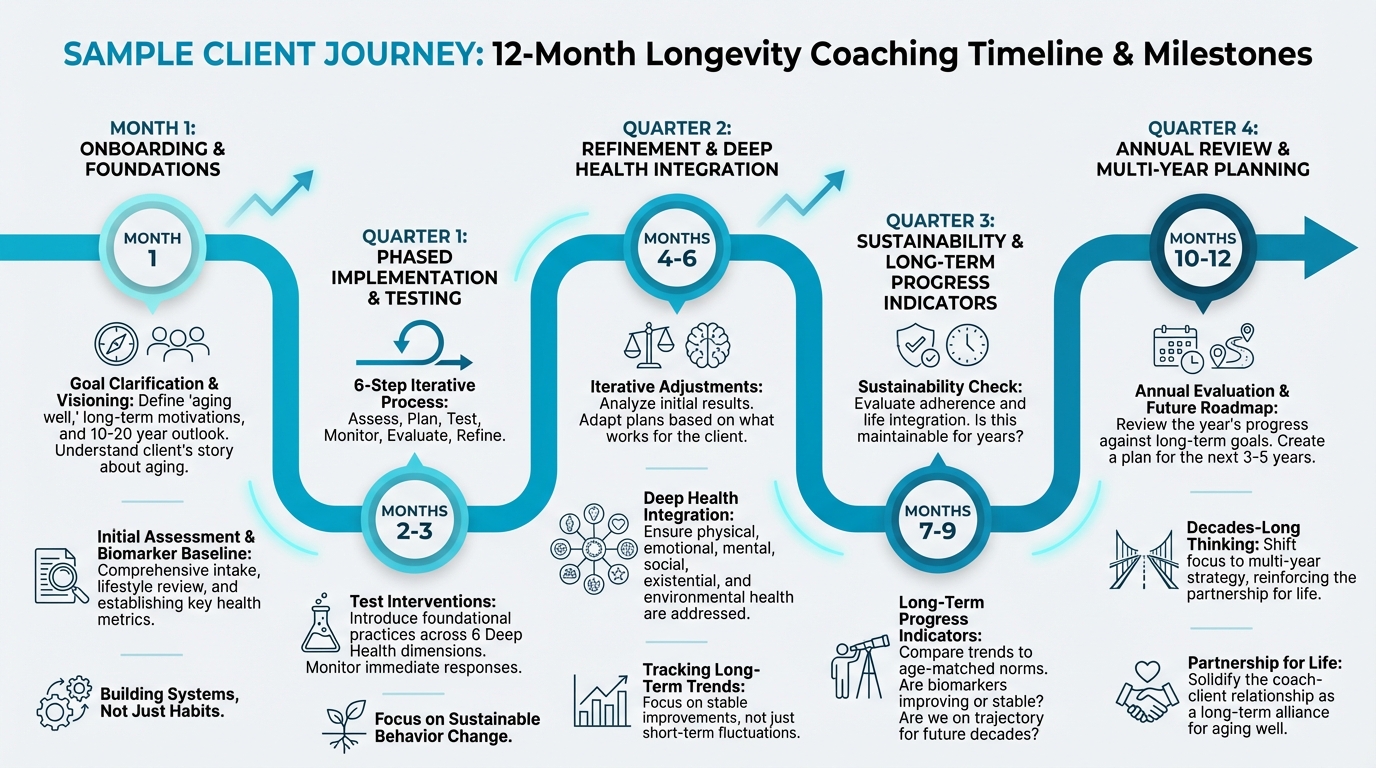
Figure: 12-month example with milestones
Month 1: Foundation
Goal: Establish baseline, build trust, create 1-2 core habits
The first month is about understanding and laying groundwork, not transformation. You’re conducting a thorough assessment, clarifying long-term goals, and identifying the single most impactful intervention to start with. If this feels “slow,” that’s usually a good sign. You’re playing the long game.
Weeks 1-2: Complete Deep Health assessment across all six dimensions and gather longevity-specific data while you work to understand their story, values, and barriers, and build the coaching relationship.
Weeks 3-4: Choose 1-2 "Big Rock" interventions based on what you learned, test them with clear parameters, provide support and accountability, and adjust based on early feedback.
Success at Month 1 looks like: The client feels understood and supported, and one or two core habits are in motion, even if adherence isn't perfect. Baseline data is collected, a clear long-term vision exists, and a communication rhythm is established. If that sounds like a lot for one month, you’re not wrong; the win is that it’s focused. You’re not trying to “fix” a whole life in four weeks, and that’s exactly the point.
Example: For Sarah, Month 1 might focus entirely on sleep. If she's running on 5-6 hours, that's the foundation everything else will build on, so the target is 7 hours, a consistent bedtime, and basic sleep hygiene, without piling on anything else yet.
Month 2: Expansion
Goal: Add 2-3 more interventions, build systems
With the foundation in place, Month 2 expands carefully by evaluating what worked in Month 1, deciding what to continue or adjust, and then adding new interventions that build on the base you’ve already laid down. Think steady upgrades, not a total overhaul.
Week 1: Evaluate Month 1 (what worked, what didn’t, and what barriers emerged), then decide what to continue, adjust, or stop.
Weeks 2-4: Add 2-3 additional interventions based on Month 1 learnings and build systems: routines, environments, social support, integrating across Deep Health dimensions.
Success at Month 2 looks like: 3-5 interventions are active and relatively sustainable, and systems are forming: routines, environments, support. Progress is visible across multiple dimensions, and client confidence is building. This is often where momentum starts to feel real, even if things are still a little messy.
Example: For Sarah, Month 2 might add daily movement (10-minute walks) and one stress management practice (5-minute breathing before bed). The sleep improvements from Month 1 give her more energy to actually do these things.
Month 3: Optimization
Goal: Fine-tune, create long-term roadmap, establish maintenance systems
Month 3 transitions from building to sustaining, which means you keep what’s working, address what isn’t, and set up structures the client can live with long-term. Most of the time, “optimize” just means making things simpler and more repeatable.
Weeks 1-2: Evaluate all interventions, optimize what's working, increase intensity or complexity if appropriate, adjust or remove what isn't working, and ensure everything is sustainable long-term.
Weeks 3-4: Create a detailed multi-year roadmap (1-year, 3-year, 5-year vision), establish maintenance systems, and plan ongoing coaching structure: frequency of check-ins, reassessment schedule.
Success at Month 3 looks like: Clear roadmap for the next 1-3 years and sustainable systems in place, with the client confident in the long-term plan and ongoing coaching structure established. It’s a lot of planning, and it’s also what turns short-term effort into long-term change.
Example: For Sarah, Month 3 creates her Year 1 roadmap: maintain sleep and movement gains, add basic nutrition improvements (protein at meals), continue stress management, and her Year 2-3 roadmap focuses on optimizing biomarkers, adding strength training, and building a complete routine.
Adapting the 3-Month Strategy
This approach is a guide, not a rigid protocol. Some clients move faster because they're highly motivated and ready for more, while others need slower pacing because they’re overwhelmed, unsure about change right now, or dealing with complex situations. Either way, you adapt to the person in front of you. Sometimes “slow” is the smart choice.
For clients with existing health conditions: Coordinate with healthcare providers, prioritize interventions that support medical treatment, and be extra careful about scope.
For clients in crisis: Address immediate barriers first and stabilize before optimizing; sometimes "not getting worse" is the right Month 1 goal.
For highly motivated clients: You can move faster, but still maintain the phased approach, and don't let enthusiasm lead to unsustainable overload.
The principle remains: build gradually, create systems, prioritize sustainability over speed.
| For DIY Learners |
|---|
| Applying this to yourself: You can use this same 3-month approach for your own longevity journey. In Month 1, focus on ONE behavior (probably sleep, because it affects everything); in Month 2, add a second behavior while maintaining the first; and in Month 3, optimize and create your own roadmap. The key is resisting the urge to do everything at once. Even without a coach, the phased approach works. |
Coaching in Practice: Reviewing Month 1 with a Busy Client
What NOT to do:
❌ Treat Month 1 results like a pass/fail report card and lecture Marcus about missed targets.
Why it doesn't work: He'll feel judged rather than coached, and is more likely to disengage just when you're building the relationship.
What TO do:
✅ Use Month 1 data to normalize imperfection, highlight progress, and collaborate on tiny, realistic next steps.
The scenario: Marcus, 52, is a business owner who wants to "age well and stay active." His assessment reveals: VO2 max 32 (below target), grip strength 68 lbs (good), elevated blood pressure, strong family support, demanding work, clear purpose ("be there for grandkids").
Month 1 Conversation (Week 4):
Coach: "Marcus, we're wrapping up your first month, so let’s look at what happened and what we learned. Your sleep target was 7-8 hours, and you averaged about 6.5, which is better than your starting point of 5-6. For daily walks, you hit 18 out of 28 days, about 64%. How does all of that feel to you?"
Marcus: "Honestly, I thought I'd nail this, and 64% feels like a C-minus."
Coach: "I get that, and I can see why it lands that way. At the same time, here’s another way to look at it: you travel constantly for work, and you still went from almost no walking to walking more than half the days, even on the road, plus your sleep improved by about an hour. That’s not a C-minus, that’s you building a foundation under difficult circumstances."
Marcus: "I guess I didn't think about the travel piece."
Coach: "Totally fair. When the walks didn’t happen, what usually got in the way?"
Marcus: "Meetings running late, mostly. And when I'm traveling, I just crash at the hotel."
Coach: "Got it. In that case, we probably need travel-specific strategies, not more willpower. What if we made the walk shorter but more consistent, like five minutes instead of ten, so you could do it even in a hotel hallway?"
Marcus: "That sounds almost too easy."
Coach: "Easy is the point right now, because we’re building the pattern first, and once walking feels more automatic, we can start nudging the duration up. Would you be willing to try five minutes for Month 2?"
Marcus: "Yeah, I can do five minutes."
Coach: "Sounds good, five minutes it is, and since that feels doable, I want to add one more small thing this month: a 5-minute breathing practice before bed to help with sleep quality and stress. Are you in?"
Marcus: "Let's do it."
Key takeaway: Progress isn’t perfection. Adapt to the client’s real life, not an ideal scenario.
[CHONK: The Long Game - Multi-Year Planning]
The Long Game: Multi-Year Planning and Sustainability
Most coaching focuses on short-term goals: lose 20 pounds in 12 weeks, run a 5K in 8 weeks. Those goals can be helpful, but they’re not enough for longevity because longevity outcomes take time. Biological age shifts slowly, disease prevention requires years of consistent behavior, functional capacity improves gradually, and some biomarkers need years of intervention before they show meaningful change.
That’s why multi-year planning matters, even if you’re also working on very immediate goals.
If thinking in multi-year, or even multi-decade, timelines feels overwhelming, that’s normal, and it doesn’t mean you’re “behind” because you don’t have the next 10 years mapped out. You and your clients build this step by step, and you’ll keep coming back to the same core priorities.
The Multi-Year Roadmap Approach
Here’s a simple way to think about the long arc of longevity coaching: You don’t need a 10-year spreadsheet.
Year 1: Foundation: Establish core habits and baseline improvements by focusing on the Big Rocks: sleep, movement, basic nutrition. At the same time, start building systems (routines, environments, support) so clients can feel early on that lasting change is possible, with early wins that don’t burn people out.
Years 2-3: Expansion: Add interventions based on what you learned in Year 1, then optimize systems and fine-tune what’s working so you can target specific biomarker improvements. This is often where steady effort starts showing up in the numbers, not overnight, but over time.
Years 4-5: Mastery: Maintain gains and prevent decline while adapting to life changes (career shifts, family changes, health challenges). By now, systems should run more smoothly and require less conscious effort.
Years 6-10+: Long-term maintenance: Sustain what’s working and adapt to aging-related changes (recovery needs shift, priorities evolve) while building resilience for disruptions, as the goal shifts from “optimize” to “maintain and protect.”
Decades of continuous adaptation: Aging brings ongoing changes, so systems need to evolve and goals may shift from performance to function to independence. The process never really ends; it just adapts, which means you can keep adjusting instead of “starting over.”
Building Systems for Sustainability
Habits are good, but systems are better, especially when life gets messy. A habit is a single automatic behavior, while a system is an interconnected set of habits, environments, routines, relationships, and identities that makes healthy choices feel much more inevitable. Less white-knuckling, and more “this is just what I do.”
Habits are the what: the specific behaviors (morning walk, protein at breakfast).
Environments are the where: physical spaces designed to support healthy choices (home gym, prepped food in fridge, sleep-friendly bedroom).
Routines are the when and how: sequences of behaviors that become automatic (morning routine, Sunday meal prep).
Social networks are the who: people who provide support, accountability, and shared values around health.
Identity is the why: how clients see themselves ("I’m someone who exercises" vs. "I’m trying to exercise").
Systems are more resilient than individual habits because they’re self-reinforcing. If one habit breaks, the system helps it recover, and when the environment supports the behavior, willpower matters less. When the social network also values health, staying on track usually gets easier, too. You don’t need a perfect streak.
Research shows habits take a median of 59-66 days to reach automaticity, with individual ranges from 4 to 335 days.³ But that’s just the habit. Building a complete system takes longer, which is exactly why longevity coaching thinks in years, not weeks.
Adapting to Life Changes
Life changes, and even the best plan will need edits. Careers shift, families grow, health challenges emerge, and priorities evolve, so longevity coaching has to adapt rather than break.
Career changes: New job, different schedule, more or less stress. Adaptation: adjust routines, find new times for habits, adapt to the new environment.
Family changes: New baby, aging parents, kids' schedules. Adaptation: integrate habits into family life, adjust expectations temporarily, involve family in health behaviors.
Health changes: Injury, illness, new diagnosis. Adaptation: work with healthcare providers, focus on what’s possible, adjust interventions to support recovery.
Aging-related changes: Recovery takes longer, priorities shift, function changes. Adaptation: reduce intensity, increase recovery time, focus on maintaining function rather than improving performance.
The key is flexibility within structure. Systems are resilient, but they also need to bend when life demands it, so help clients adjust rather than abandon when circumstances change. If a client feels frustrated by this, that’s normal. It doesn’t mean they’re failing; it means they’re human and paying attention.
Long-Term Monitoring Plan
Longevity coaching requires monitoring at multiple timeframes:
| Timeframe | What to Monitor | Purpose |
|---|---|---|
| Daily | Behaviors happening? How do you feel? | Catch issues early, maintain awareness |
| Weekly | Progress, barriers, adjustments needed | Course-correct quickly |
| Monthly | Trends, intervention effectiveness | Evaluate what's working |
| Quarterly | All six Deep Health dimensions, biomarker trends | Full check-in |
| Annually | Full assessment, biomarkers, roadmap review | Big picture evaluation |
Daily tracking keeps clients aware, quarterly reviews make sure you’re addressing the whole person, and annual assessments give you the bird’s-eye view that guides the next year’s roadmap. You’re zooming in and out on purpose.
Coaching in Practice: "What's the 5-Year Plan?"
What NOT to do:
❌ Jump straight into prescribing an intricate 10-year protocol without connecting it to her actual life or what independence means to her.
Why it doesn't work: A plan that feels abstract or overwhelming is unlikely to stick, and she may assume longevity coaching is only for "perfect" people.
What TO do:
✅ Start by clarifying what "aging well and staying independent" look like for her, then co-create a simple high-level roadmap that links today's actions to that future.
The scenario: Elena, 40, is a teacher who wants to "age well and stay independent." After her initial assessment, you're creating her long-term roadmap together.
Coach: "Elena, can we zoom out for a minute? You’re 40 now. When you imagine yourself at 60, 70, 80, what do you want life to look like?"
Elena: "I want to still be hiking, gardening, and traveling. I don’t want to be dependent on anyone. I watched my grandmother need help with everything by 75, and that terrified me."
Coach: "So independence and capability are the north star. We can work backward from there. At 70, what would you need to be able to do to live independently?"
Elena: "Get up off the floor without help, carry groceries, walk a few miles without being exhausted, and think clearly enough to manage my own life."
Coach: "Those are specific, trainable capacities. Getting up from the floor is the sit-to-rise test we did; walking endurance maps to VO2 max; carrying groceries is strength; and clear thinking is cognitive function. We can measure all of those, and we can improve all of them."
Elena: "So we're not just hoping for the best, we're actually training for specific abilities?"
Coach: "Exactly, and that’s the point of the roadmap. Here’s how I’d think about yours:
Year 1, we're building your foundation—sleep, consistent movement, and basic nutrition—while getting your VO2 max from 32 to at least 35 and building a strength routine.
Years 2-3, we expand by adding Zone 2 cardio specifically for endurance, progressing your strength training, and optimizing nutrition for muscle preservation and brain health.
Years 4-5, we're maintaining and fine-tuning so that these behaviors feel automatic, and we’re preventing decline, not just improving.
Then, over the next decades, we adapt as your life changes, but we protect those core capacities that let you stay independent. You’re building a base you can keep returning to."
Elena: "I've never thought about it that way. It's not about being perfect right now. It's about building toward being capable later."
Coach: "That’s it exactly. And here’s the encouraging part: you’re starting at 40, not 60, so everything we do now is banking capacity for later. What feels like the most important first step?"
Elena: "Honestly? Sleep. I'm running on 6 hours and I know it's catching up with me."
Coach: "Perfect. We’ll start with sleep."
Key takeaway: Multi-year planning provides direction and meaning. Connect short-term actions to long-term vision.
[CHONK: The Longevity Protocol at a Glance]
The Longevity Protocol at a Glance
You already understand the coaching process, including how to assess, strategize, and build systems over years. In this chapter, we’re going to zoom out and look at what you’re actually coaching, so you can see the full longevity protocol before you head into the detailed chapters in Units 2 and 3. Think of this as the “big picture” you’ll keep coming back to.
This section can serve as your map, with the chapters ahead as individual “territories” we’ll explore in depth, and it’s easier to navigate once you can see the whole layout. If it feels like a lot to hold in your head right now, that’s normal, and you don’t need to memorize any of it; you’ll revisit this overview again and again as you coach.
The Priority Order
Not all interventions are created equal. When we prioritize based on effect sizes and the research, the order looks like this:
- Exercise, because it has the largest effect on mortality and function overall
- Sleep, because it’s foundational and supports everything else you’re trying to change
- Stress Management / Recovery, which is often underestimated but shapes whether plans stick
- Nutrition, which matters a lot, but usually isn’t the first lever for most people
If that order surprises you, you’re in good company. Many clients assume nutrition comes first, or that supplements and biohacks matter most, but the research points us in a different direction. Exercise is the single most powerful longevity intervention we have; sleep is the foundation that helps everything else work; stress management often determines whether good intentions turn into sustained behaviors; and nutrition (while important) tends to work best when those other foundations are already in place.
If you’re reading this and thinking, “Wait, exercise before nutrition?”, that reaction is super common, and it’s a helpful coaching moment because it gives you a chance to reset expectations early.
This is also where “big rocks first” coaching becomes really practical, and honestly, it can be a huge relief.
What not to do
Client: “I found this supplement stack online, and I’m wondering if I should start it.”
Coach: “Sure. I’ll build you a full supplement stack right now, and I’ll send you a list of what to buy.”
Client: “Okay… where do we start?”
Coach: “We’ll just add it all in and see what happens.”
A better redirect (same client, same goal)
Client: “I found this supplement stack online. Should I start it?”
Coach: “I love that you’re motivated and doing research. Before we spend money and energy on supplements, can I ask how sleep is going right now?”
Client: “Honestly, about five hours most nights.”
Coach: “That’s helpful to know, and it tells me we should get the big rocks in place first, especially sleep and exercise. Once those are more consistent, we can decide whether any supplements are actually worth adding.”
The Key Domains
The longevity protocol covers eight interconnected domains. At a high level:
Testing (Assessment)
- Recommended: DEXA (bone density, body composition), full bloodwork panel, VO2 max testing, grip strength tracking, blood pressure monitoring, strength and mobility testing
- Optional: HRV tracking, food sensitivity testing, micronutrient testing, coronary calcium scoring
Nutrition
- Primary approach: Mediterranean/MIND diet principles
- Protein: 0.7-1.0 grams per pound of body weight daily (target 30g+ per meal)
- Fiber: 30-50 grams daily from diverse sources
- Blood sugar management: protein-first meals, walk after eating, avoid isolated carbs
- Hydration: 0.5-1 oz per pound body weight
- Alcohol: 2-4 drinks/week maximum
Exercise / Movement
- Strength training: 3-5x/week (compound lifts: squats, deadlifts, presses)
- Zone 2 cardio: 150-300 minutes weekly (60-70% max HR)
- VO2 max training: 1x/week (high-intensity intervals)
- Mobility work: Daily 10-15 minutes
- Balance training: 2x/week (single-leg work, instability training)
- Bone-loading: Jump rope or plyometrics 3x/week
Sleep
- Duration: 7-9 hours consistently
- Consistency: ±30 minutes same sleep/wake time
- Environment: 65-68°F, complete darkness, minimal noise
- Timing: Last meal 2-3 hours before bed, no caffeine after 1pm
- Morning light: Sunlight within 30 minutes of waking
Stress Management / Mental Health
- Daily meditation: 10-20 minutes
- Breathwork: 5-10 minutes 2x/day (box breathing, physiological sighs)
- Nature exposure: 20+ minutes daily outdoors
- Journaling: Daily reflective or gratitude practice
- Therapy: Proactive support, especially during transitions
- Limit: Social media, caffeine after 1pm, work hours
Recovery / Regeneration
- Sauna: 4+ sessions/week at 176-195°F for 17-20 minutes
- Cold exposure: 2-4 minutes, 3x/week (4+ hours after resistance training)
- Tissue work: Self-myofascial release 5-10 minutes daily
- Deload weeks: Every 4-6 weeks, reduce volume by 40-50%
Environment
- Air quality: HEPA filtration, monitor VOCs
- Water: High-quality filtration (remove chlorine, heavy metals)
- Food storage: Glass or stainless steel (minimize plastic)
- Personal care: Free from parabens, phthalates, synthetic fragrances
- Noise: Minimize background sound, quiet sleeping space
Emotional Regulation / Social Connection
- Daily meaningful conversation with partner or friend (target 1 hour)
- 2+ weekly in-person interactions with friends
- Purpose definition: Written purpose statement, revisited quarterly
- Community: Shared interest groups, volunteering, mentorship
- Repair protocols: Invest in conflict resolution with loved ones
If reading that list makes you think, “Wait, I’m supposed to coach all of this?”, you’re not alone. This is the full map, not the day-one checklist, and you’ll build into it over time. Almost nobody starts with all eight domains at once.
The Non-Negotiables
If a client does nothing else, these six things matter most:
| Non-Negotiable | Why It Matters |
|---|---|
| 150 min exercise weekly (strength + cardio) | Largest mortality reduction of any intervention |
| Sleep 7-9 hours consistently | Foundation for recovery, cognition, metabolism |
| Adequate protein (30g per meal target) | Prevents sarcopenia, supports metabolic health |
| Strong relationships/social connections | Social isolation rivals smoking for mortality risk |
| Annual bloodwork | Catches issues early, enables tracking |
| Don't smoke / limit alcohol | Smoking is #1 modifiable risk; alcohol has no safe level |
These aren’t arbitrary. They’re the interventions with the largest effect sizes in the research, and everything else, including supplements, biohacks, and optimization protocols, builds on this foundation. As the protocol states: "80% adherence to a good protocol beats 40% adherence to a perfect protocol." That’s good news.
If you or your clients aren’t consistently doing all of these yet, that’s okay. Most people aren’t when they begin. Your work together is to keep moving toward these foundations one step at a time, because they’re still the main levers for health and longevity. Progress counts.
The Implementation Strategy
The protocol includes a specific phasing strategy that aligns with what you learned about the 3-month onboarding.
A common misstep (same idea as above): trying to do everything at once
Client: “I want the full protocol. Can we do all three months at once?”
Coach: “Absolutely. We’ll overhaul everything right away: training, sleep, nutrition, sauna, supplements, environment, and we can stack it all this week.”
Client: “Okay… I’m already busy.”
Coach: “No problem. Just push through.”
A better approach (same client, same goal)
Client: “I want the full protocol. Can we do all three months at once?”
Coach: “I hear the motivation. To make this stick, we’ll phase it. What would feel most doable to start with: sleep consistency or two strength sessions per week?”
Client: “Probably sleep.”
Coach: “Great, we’ll start there in Month 1, then layer in the rest.”
Month 1: Foundation
- Optimize sleep (the keystone habit)
- Do strength training 3x/week
- Hit protein targets at each meal
- Add core supplements (if appropriate)
- Complete baseline testing (bloodwork, DEXA, VO2 max)
Month 2: Expansion
- Add Zone 2 cardio
- Introduce sauna/cold (if available)
- Refine the nutrition approach
- Build a social connection focus
- Develop stress management practices
Month 3: Optimization
- Add VO2 max training
- Add a full supplement stack (if appropriate)
- Do an environmental audit and make improvements
- Schedule follow-up biomarker testing
Ongoing: Refinement
- Do quarterly assessments
- Adjust the protocol based on data
- Continue education
- Build community support
This phasing helps prevent overwhelm while still making sure nothing important gets skipped. Notice how sleep and strength come first, because they’re foundations that tend to make everything else easier. Clients often want to start anywhere but there, and that’s normal.
How This Connects to What's Ahead
This protocol overview gives you the complete picture, and the chapters ahead will explore each domain in depth:
-
Unit 2 (Chapters 7-14) covers the core interventions: nutrition, metabolic health, exercise, movement quality, sleep, stress, recovery, and environment.
-
Unit 3 (Chapters 15-21) covers advanced topics: supplements, cardiovascular health, metabolic disease, neuroprotection, cancer prevention, and hormone health for women and men.
-
Chapter 4.22 provides the prioritization system (the "Hierarchy of Longevity Needs") that helps you decide what to focus on with each client.
As you move through these chapters, it helps to keep this overview in the back of your mind. Each chapter explores one piece of the larger picture in detail, and your job as a coach is to help clients work with the whole map, not just optimize one corner of it.
Summary
Longevity coaching requires a different approach than short-term coaching because you're planning for decades (not weeks) while tracking biomarkers and all six Deep Health dimensions along the way. In other words, you're building systems, not just habits, and you're working with the whole person at every step.
PN's 6-step coaching process works perfectly for longevity, with adaptations:
| Step | Standard Coaching | Longevity Adaptation |
|---|---|---|
| 1. Assess | Current state, short-term goals | Full longevity assessment, all six dimensions |
| 2. Understand | Motivations, barriers | Story about aging, values, purpose, long-term vision |
| 3. Strategize | 12-week plan | Multi-year roadmap, phased implementation |
| 4. Choose | Test an intervention | Evidence-based, systems-building focus |
| 5. Observe | Weekly progress | Long-term trends, biomarker tracking |
| 6. Analyze | Did it work? | Sustainability check, roadmap adjustment |
The 3-month onboarding provides structure for new clients:
- Month 1: Foundation. 1-2 core habits, assessment, relationship building
- Month 2: Expansion. Add 2-3 interventions, build systems
- Month 3: Optimization. Fine-tune, create long-term roadmap
Multi-year planning is essential because longevity outcomes take years to manifest, so you’re aiming for a roadmap that spans decades: foundation → expansion → mastery → maintenance → adaptation.
Systems (not just habits) are what make longevity coaching sustainable, because you’re building habits, environments, routines, social support, and identity that reinforce each other. This is where “small changes” start to compound.
Longevity coaching is a long-term partnership. You’ll use the 6-step process iteratively, adapt to each client’s unique situation, and keep the focus on systems that last for years. That’s how you help clients thrive across all dimensions of Deep Health for decades to come.
Study Guide Questions
These questions can help you check your understanding and practice turning the “big picture” into real coaching decisions. No need to write a dissertation for each one.
-
When you adapt the PN 6-step coaching process to longevity coaching, what changes in emphasis, time horizon, and measurements compared to short-term coaching?
-
Why does phased implementation (3-month onboarding) usually work better than trying to change everything at once, especially for clients who are already busy or stressed?
-
How would you explain the difference between building habits and building systems, and why do systems matter more for longevity outcomes?
-
In practice, how do you weave all six Deep Health dimensions into each step of the coaching process without overwhelming the client?
-
What is a multi-year roadmap, and how would you sketch a first version for a 45-year-old client who says they want to "optimize for longevity"?
-
What are "Big Rocks" vs. "Sand" in longevity coaching, and how would you use that idea to prioritize interventions for a real client?
-
How do you monitor progress in longevity coaching, and what’s meaningfully different from how you’d track progress in short-term coaching?
-
If a client is frustrated that their biomarkers haven’t improved after 6 weeks, how would you respond in a way that’s both honest and motivating? This is a common moment.
-
How would you adapt the 3-month onboarding strategy for different clients, such as highly motivated vs. overwhelmed, or simple vs. complex situations?
-
What specific systems would you help a client build for long-term sustainability, so the plan still works on hard weeks (not just easy ones)?
Self-reflection questions:
-
Walk through the 6-step process with yourself as the client. What would your assessment reveal, what do you understand about your own "why" for longevity, and what’s one small action you could test this week?
-
Looking at your own long-term health, what systems (not just habits) do you already have in place, and what environment design could make your healthy behaviors more automatic?
[CHONK: Works Cited]
Deep Dives
[CHONK: Works Cited]
Further Reading
If you’d like a little extra context, these short articles take a closer look at a couple key topics from this chapter. If now isn’t the moment, feel free to bookmark them and come back when you’re ready.
- Case Study: First 90 Days with a New Client: A step-by-step walkthrough of the early stages with a new client
- Long-Term Monitoring: What to Track and When: A practical schedule for what to track and when, as coaching continues over time
References
If you want to see where the research and ideas came from, here are the sources. You don’t need to read them all right now; just use them when you want to look more closely.
-
Gollwitzer PM. Implementation intentions: Strong effects of simple plans. American Psychologist. 1999;54(7):493-503. doi:10.1037/0003-066x.54.7.493
-
Fujii M, Nakano J, Tanaka Y, Tonosaki A. Effects of self-management interventions with behavior-change support on long-term adherence in patients with chronic respiratory diseases: A systematic review. GHM Open. 2022;2(1):12-24. doi:10.35772/ghmo.2022.01000
-
Singh B, Murphy A, Maher C, Smith AE. Time to Form a Habit: A Systematic Review and Meta-Analysis of Health Behaviour Habit Formation and Its Determinants. Healthcare. 2024;12(23):2488. doi:10.3390/healthcare12232488
-
Papachristou Nadal I, Chauhan AS. Effectiveness of Behaviour Change Techniques and Theories on Lifestyle Interventions of Non-Communicable Diseases: An Umbrella Review. SSRN Electronic Journal. 2023. doi:10.2139/ssrn.4355393
-
Holt-Lunstad J, Smith TB, Baker M, Harris T, Stephenson D. Loneliness and Social Isolation as Risk Factors for Mortality. Perspectives on Psychological Science. 2015;10(2):227-237. doi:10.1177/1745691614568352
-
Almulhim AN, Hartley H, Norman P, Caton SJ, Doğru OC, Goyder E. Behavioural Change Techniques in Health Coaching-Based Interventions for Type 2 Diabetes: A Systematic Review and Meta-Analysis. BMC Public Health. 2023;23(1). doi:10.1186/s12889-022-14874-3
You’ve made it through the Foundations, which is a big deal, so nice work.
Chapter 1.6 and Unit 1: Foundations are complete; proceed to Unit 2: Core Interventions.