Unit 4: Coaching for Longevity
Chapter 4.27: Behavior Change for the Long Haul
[CHONK: Introduction]
One key truth separates longevity coaching from most other health work: You're not training someone for a 12-week transformation. You're helping them build a life, one that can hold up through the messy, real-world stuff, because life always happens.
Most clients who come to you have tried programs before, like the 30-day challenge, the 8-week boot camp, or the quick-fix detox. And now they're here again, which usually tells you those approaches didn't translate into something they could keep doing.
The statistics are humbling: Research shows that roughly 30-35 percent of weight lost through intensive programs is regained within the first year,1 and by year five, many intervention effects fade entirely. In one five-year follow-up of a digital health behavior support system, researchers found no significant difference between intervention and control groups.2
Those numbers can feel discouraging, and that's a normal reaction. It doesn't mean you're being negative; it means you're paying attention.
This isn't because people lack willpower. It's because short-term programs are designed for short-term results, and they often don't address the real question: How do you maintain healthy behaviors across decades, through job changes, family crises, health scares, and the general chaos of being human?
That's what this chapter is about.
[CHONK 1: The Decade View: Why Longevity Coaching is Different]
Thinking in years, not weeks
When someone hires a personal trainer for a wedding, the goal is clear: look good in photos on a specific date. The timeline is finite, the motivation is external, and sustainability doesn't matter; they just need to get there.
Longevity coaching is the opposite: Your clients aren't preparing for an event. They're preparing for the next 20, 30, or 40 years of their lives, which means the people who succeed at long-term behavior maintenance aren't the ones who go hardest. They're the ones who keep going.
That takes a real mindset shift, both for you and for your clients. If that feels like a bigger job than "write a program," you're exactly right. And that's why this work matters.
The adherence paradox
This might sound counterintuitive, but 80 percent adherence sustained over years beats 100 percent adherence that burns out in months.
We call this the "adherence paradox." The client who exercises five days a week consistently for three years gets better results than the one who trains seven days a week for six months and then completely stops.
Research supports this. Long-term maintainers (people in registries like the National Weight Control Registry who've kept weight off for a decade) don't follow perfect protocols.3 Instead, they build systems that work in their actual lives, recover from setbacks, and adjust when circumstances change. That's the goal: progress you can repeat.
One meta-analysis found that habit-focused interventions increased physical activity habit strength compared to controls, with shorter follow-ups (12 weeks or less) showing larger effects than longer ones.4 In other words, this suggests building the habit matters more than optimizing the specific behavior. That's good news.
Identity versus outcomes
There's a meaningful difference between "I'm trying to lose weight" and "I'm a person who takes care of my health." They can sound similar, but they behave very differently.
The first is an outcome goal: external, measurable, and, critically, it has an endpoint. Once you lose the weight, what then? For many people, motivation fades because the "project" is over.
The second is an identity statement. It describes who you are, not just what you're trying to achieve, and because identity is ongoing, so is the behavior that supports it.
Research on "future self-continuity," the degree to which people feel connected to their future selves, shows this matters for behavior.5 People who can vividly imagine their future selves make more health-protective choices in the present: They save more money, exercise more, and engage in fewer risky behaviors.
Getting started is different from staying started
A lot of coaches and clients get tripped up here: the strategies that help you adopt a new behavior aren't the same as the strategies that help you maintain it.
Coach: "When you first started, what was helping you stick with it?"
Client: "Honestly? The novelty, and checking things off every day."
Coach: "Great. We'll plan for what happens after the novelty wears off, so you don't have to rely on willpower forever."
During adoption (first 1-3 months), people rely heavily on:
- Conscious intention and decision-making
- Novelty and excitement ("This is my new thing!")
- External motivation (wanting to look good, please others, meet a goal)
- Active willpower and self-control
- Detailed tracking and monitoring
During maintenance (after the behavior is established), successful changers have shifted to:
- Habit and automaticity (it just happens)
- Identity ("I'm someone who does this")
- Internal motivation (I enjoy this, this is who I am)
- Environmental defaults (my life is set up for this)
- Minimal-effort systems
The transition between these two phases is where many people struggle. They either use adoption strategies forever (relying on willpower, staying hyper-vigilant, treating every day like a test of discipline) and eventually burn out, or they drop all the adoption strategies too early, before the behavior has become automatic, and drift back to old patterns.
What this means for coaching: Help clients recognize which phase they're in. During adoption, more structure and accountability are appropriate; as behaviors stabilize, actively help clients shift from willpower mode to autopilot mode. The goal is to make the healthy choice the default choice, something that happens without much thought or effort. If that sounds like a tall order, remember you're building a system, not winning a single perfect day.
What success looks like over 10+ years
Long-term success looks different than short-term success. Here's what the research shows about people who maintain healthy behaviors for years, and it's more human than many people expect:
They're not perfect. The National Weight Control Registry found that over 87 percent of members maintained at least 10 percent weight loss at both 5 and 10 years, but this was a self-selected group of highly motivated people, and even they had ups and downs.3
They stay engaged. One analysis of a low-cost weight management program (TOPS) found that members who renewed annually maintained an average weight change of -6 percent at one year and -8.3 percent at seven years.6 Continued participation predicted continued success.
They adapt. Long-term maintainers use proactive planning and continued self-monitoring, while regainers tend to relax monitoring and planning over time.7
They have support. Social context is pivotal: peers and family who support healthy behaviors facilitate long-term maintenance, while unsupportive social environments predict relapse.8
Predictors of long-term success
The research identifies several factors that predict better long-term adherence:
- Older age (yes, really, older adults often have more stable routines)
- Higher education and socioeconomic status (access to resources matters)
- Larger initial success (early wins build momentum)
- Higher readiness to change at baseline
- Lower depression and stress (mental health affects everything)
- Intrinsic motivation (doing it for yourself, not external validation)9,10
Motivation type matters, too. One study found that participants motivated by stress reduction had nearly three times higher odds of progressing toward lifestyle goals, while those primarily motivated by weight loss had lower odds of success.11 This suggests that framing behavior change around how you want to feel, rather than how you want to look, may support longer-term maintenance.
Coaching in Practice: The 10-Year Client
Before we jump into tools and tactics, here's the vibe you're aiming for with a "10-year client": steady, flexible, and built for real life.
What NOT to do
Coach: "Okay, we're going to do this perfectly: seven workouts a week, no days off, and you're tracking everything. If you miss, we start over."
Client: "I can try, but... that sounds like a lot with my job and the kids."
Coach: "You'll just have to want it more."
A better coaching conversation
Client: "I always start strong, and then life happens and I fall off."
Coach: "That makes sense. Life does happen. Can we zoom out for a second and think in years, not weeks?"
Client: "Yeah. I want this to stick, not be another short-term thing."
Coach: "Perfect. In the first 1-3 months, we'll use more structure, accountability, and maybe some tracking. Then, as this gets more automatic, we'll simplify and set up your environment so the healthy choice becomes the default."
Client: "So the goal isn't to be perfect. It's to keep going."
Coach: "Exactly. Eighty percent consistency you can repeat for years beats 100 percent that burns you out in months."
[CHONK: Coaching in Practice - The 10-Year Client]
Marcus, 52, comes to you after losing 40 pounds on a popular program, then regaining 35 of them over the following two years. He’s frustrated and feels like a failure. Regain can feel incredibly personal, even when it’s not.
What NOT to do:
❌ Immediately plug him into another strict short-term plan without exploring what he really wants for the next decade.
Why it doesn’t work: It keeps him stuck in the same lose-regain cycle and reinforces the story that he’s a failure when the plan ends.
What TO do:
✅ Shift the focus to who he wants to be, and what he wants to be able to do, 10 years from now.
Instead of immediately diving into a new plan, try a conversation like this:
Coach: "Marcus, can I ask you something a little different? For a moment, I’d like to set weight aside. When you picture yourself at 62, 10 years from now, what do you want to be able to do?"
Marcus: "I want to be able to hike with my grandkids. Keep up with them, you know?"
Coach: "I love that, and it’s a real goal. What do you think would have to be true about your day-to-day life for that to feel possible?"
Marcus: "Probably being more consistent, and not doing extremes that lead to burnout."
Coach: "Exactly. So here’s the question: What would 62-year-old Marcus thank you for starting today? Not a crash diet, but something sustainable enough that you’d still be doing it in 10 years."
Key takeaway: This reframes the conversation from short-term weight loss to long-term capability: an identity-based, decade-view approach.
[CHONK 2: Habit Formation for Lasting Change]
The myth of 21 days
You’ve probably heard that it takes 21 days to form a habit. That number gets repeated constantly, but the research tells a different story.
A systematic review and meta-analysis of 20 studies found the median time to habit formation was approximately 59-66 days, with a mean of 106-154 days and an observed range of 4-335 days.12
That’s a wide spread: Some behaviors become automatic in under a week, while others take nearly a year. The median (the midpoint) is about two months, not three weeks. That’s good news, because it means you’re not “behind” if it’s taking longer.
If you’re realizing why some of your own past habit attempts felt harder than you expected, that’s normal. Most people were taught the 21-day story, so it can be jarring when real life doesn’t match it. That doesn’t mean you’re broken.
This matters for your clients, too. If they expect habits to feel automatic in 21 days and they don’t, they may conclude something is wrong with them, when really they’re just human. Knowing the real timeline helps you set appropriate expectations and keep the focus on steady reps instead of quick perfection.
Here’s what that can sound like in a session:
Client: "It’s been three weeks, and I still have to think about this every day. Shouldn’t it be automatic by now?"
Coach: "Not necessarily. For most habits, the midpoint is closer to two months, and some take longer. Let’s make sure the version you’re practicing is doable, then we’ll build from there."
The cue-routine-reward loop
Habits run on a predictable cycle:
- Cue (trigger): Something in the environment signals the behavior
- Routine (behavior): The action itself
- Reward (reinforcement): Something positive that makes the brain want to repeat the cycle
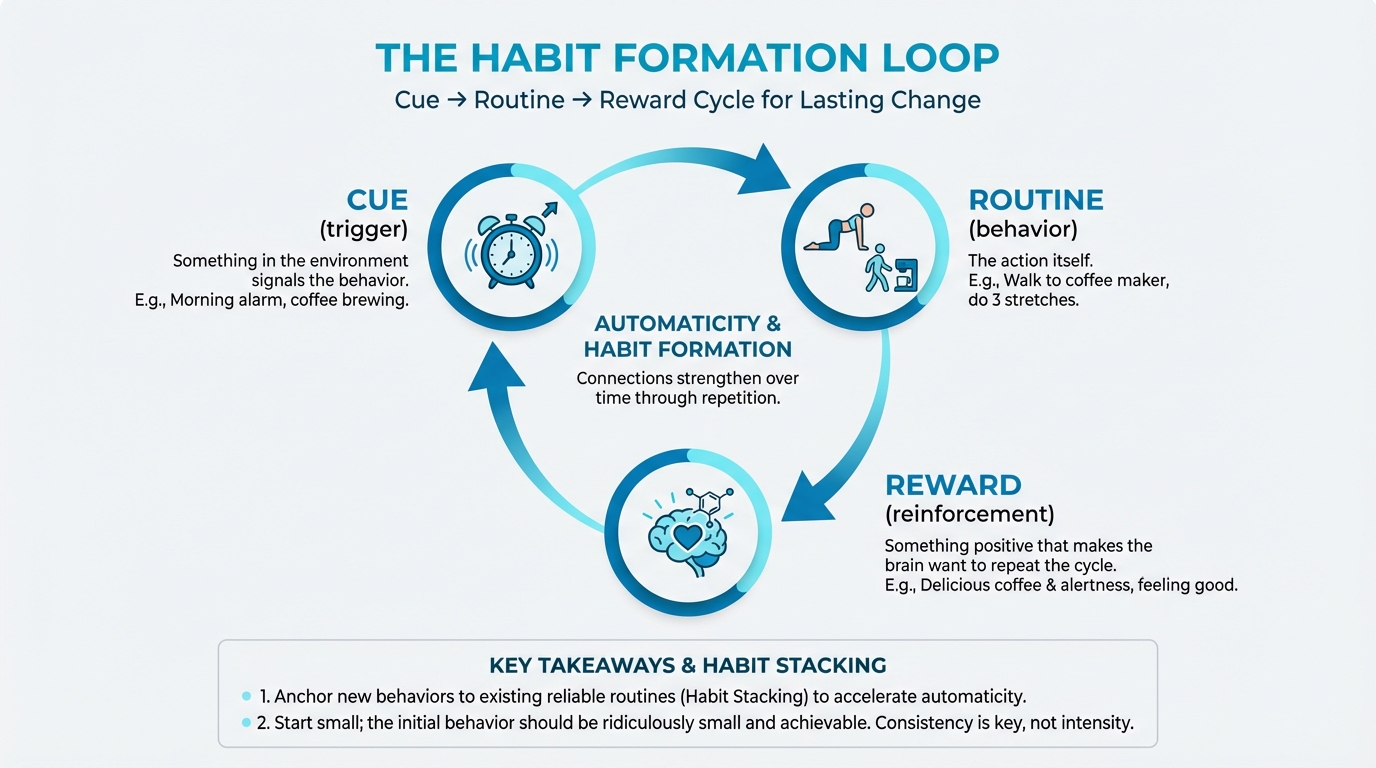
Figure: Cue → Routine → Reward cycle
For example: Morning alarm goes off (cue) → walk to coffee maker (routine) → delicious coffee and alertness (reward).
A big takeaway here is that the cue matters enormously. Research shows that repeating behaviors in stable contexts (same time, same place, same preceding event) predicts higher automaticity and greater goal attainment.13
That’s why people who exercise “when they feel like it” rarely develop an exercise habit, while people who exercise “immediately after dropping the kids at school” often do. The stable cue helps create automaticity because their environment is doing some of the work.
Context stability and anchoring
"Anchoring" means connecting a new behavior to an existing routine that already happens consistently. Research found that anchoring meditation to a fixed daily routine increased odds of daily practice by about 14 percent compared to controls.14
Practical examples of anchoring:
- Take vitamins right after brushing teeth (existing routine: tooth brushing)
- Do mobility exercises while waiting for coffee to brew (existing routine: morning coffee)
- Practice deep breathing during the drive home from work (existing routine: commute)
The existing routine serves as a reliable cue, which means you don’t have to “remember” the new behavior so much as attach it to something you already do on autopilot. Anchoring can feel almost “too easy,” and that’s fine.
Habit stacking for longevity clients
"Habit stacking" is anchoring multiple behaviors together in a chain. The formula is: After [CURRENT HABIT], I will [NEW HABIT].
For longevity clients, this might look like:
- After I pour my morning coffee, I will take my omega-3s
- After I sit down at my desk, I will do five wall push-ups
- After I brush my teeth at night, I will do five minutes of stretching
- After I park at work, I will take a 5-minute walk before going inside
The key is specificity. “I’ll exercise more” is not a habit stack, but “After I drop my keys by the door when I get home, I will immediately change into workout clothes” is.
Identity-based behavior change
Charles Duhigg and James Clear have popularized the concept of identity-based habits: the idea that lasting change comes from changing who you believe you are, not just what you do.
The progression looks like this:
- Outcome-based: "I want to lose weight"
- Process-based: "I want to exercise three times per week"
- Identity-based: "I am a person who moves my body regularly"
Each successful behavior becomes a “vote” for the identity. Over time, the identity strengthens, and the behaviors feel less like effort and more like self-expression.
This connects to the habit research. One study found that morning routines and self-selected behaviors were associated with stronger habit gains.12 When people choose behaviors that align with who they want to be, automaticity develops faster. This is one reason autonomy matters so much in coaching.
Keystone habits for longevity
Some habits seem to create positive ripple effects across other areas of life. Researchers call these “keystone habits.”
For longevity clients, common keystone habits include:
- Morning movement: People who exercise in the morning tend to make better food choices throughout the day
- Adequate sleep: Sleep affects mood, willpower, food cravings, and exercise capacity
- Meal preparation: Having healthy food available reduces reliance on willpower in the moment
- Regular check-ins: Self-monitoring (without obsession) helps maintain awareness
The strategy is simple (even if it’s not always easy): Instead of trying to change everything at once, help clients identify one keystone habit that might create positive spillover effects. If a client wants to overhaul their whole life on Monday, you can gently bring them back to one solid domino. That’s not “lowering the bar.” It’s how people actually change.
Early engagement predicts success
Here’s an important research finding: Early engagement is one of the strongest predictors of long-term success.15
In other words, what happens in the first few weeks of a behavior change program often predicts what happens months or years later. Clients who engage strongly early by attending sessions, completing activities, and building initial momentum are more likely to maintain changes long-term.
This doesn’t mean pushing clients to do more than they can sustain. It means creating conditions for meaningful early success: start with behaviors that are achievable, visible, and reinforcing, then build confidence before building complexity. That “small wins first” approach isn’t fluffy. It’s strategy.
Coaching in Practice: Building the Morning Anchor
[CHONK: Coaching in Practice - Building the Morning Anchor]
Priya, 47, wants to establish a consistent stretching routine to address her chronic back stiffness, but there’s a familiar pattern: She starts with good intentions, and then the plan quietly fades out after a while. (That’s incredibly common, by the way.)
Rather than handing her a “perfect” stretching program, you can help her build a habit stack by attaching a tiny stretch routine to something she already does on autopilot:
Coach: "What’s something you do every single morning without fail, even on your worst days?"
Priya: "Make coffee. I literally can’t function without it."
Coach: "Perfect. Want to run a quick experiment? After you press the button on your coffee maker, do just three stretches: cat-cow, child’s pose, and a standing hamstring stretch. It’ll take about two minutes, and the coffee brewing is your cue."
Priya: "That’s it? Just three?"
Coach: "That’s it. We’re not building a stretching routine yet, we’re building a habit. Once this feels automatic, we can add to it, but for now the goal is simple: connect stretching to coffee, every single day."
Key takeaway: The initial behavior is almost ridiculously small on purpose. Two minutes is doable even on terrible days (and those days happen), which helps the cue-behavior connection get stronger; once it does, you can gradually build the routine from there. |
[CHONK 3: Managing Health Anxiety and Optimization Obsession]
When "healthy" becomes unhealthy
There’s an uncomfortable truth in the longevity and wellness space: Some of your most motivated clients may also be the most at risk for developing problematic relationships with health. (Yes, even the ones who “do everything right.”)
Traits that can genuinely help someone improve their health, like conscientiousness, goal orientation, and a desire for control, can also slide into anxiety, obsession, and rigidity that undermines well-being. If you’ve seen this before, you’re not imagining it, and you’re not alone. (It’s a real pattern.)
Orthosomnia: Obsessing over sleep data
"Orthosomnia" is a term coined by sleep researchers to describe an obsessive pursuit of optimal sleep driven by tracker metrics.16 People with orthosomnia can get so focused on achieving perfect sleep scores that they develop insomnia-like symptoms, such as difficulty falling asleep, anxiety about sleep, and daytime fatigue caused by worry rather than actual sleep deprivation.
One study found that orthosomnia prevalence ranged from 3 percent (strict criteria) to 14 percent (lenient criteria) among people who use sleep trackers,17 which is not a trivial number. In that same line of research, people with orthosomnia also had significantly higher insomnia severity scores than other tracker users.
The irony stings: People who are trying so hard to sleep well can end up sleeping worse because of the effort.
The broader pattern: Wellness perfectionism
Orthosomnia fits into a bigger pattern. Research consistently links maladaptive perfectionism, meaning a rigid need to meet impossibly high standards, with higher anxiety, depression, and problematic health behaviors like orthorexia (obsessive "clean eating") and compulsive exercise.18,19
A meta-analysis found significant correlations between perfectionism and compulsive exercise, with total perfectionism showing a correlation of approximately 0.37.20 Perfectionistic concerns, like fear of making mistakes and worry about others’ judgment, showed correlations with both binge eating and compulsive exercise.
None of this means all optimization is bad. Many clients genuinely benefit from tracking, planning, and striving for improvement, but there's a line between healthy engagement and unhealthy obsession, and some clients cross it.
Signs of problematic versus healthy tracking
Here’s a simple way to sort out “this helps me” from “this runs me.” (You’re mostly looking for flexibility.)
Healthy tracking relationship:
- Uses data to notice trends and inform decisions
- Can take breaks from tracking without significant anxiety
- Data serves goals, not the other way around
- Can accept "good enough" results
- Tracking improves quality of life overall
Problematic tracking relationship:
- Feels anxious when unable to track or when data is missing
- Constantly checks metrics throughout the day
- Mood depends heavily on daily numbers
- Pursues perfect scores at the cost of actual well-being
- Cannot enjoy activities if not tracked
- Tracking creates more stress than it relieves
Research shows that most wearable users report more positive than negative emotions from tracking.21 However, among users with pre-existing anxiety or perfectionism, the relationship can become counterproductive.
The "never enough" trap
Wellness culture can feed a sense that you’re never doing enough. There’s always another supplement, another protocol, another biohack, and for some clients that turns into chronic, low-grade anxiety about falling short.
If you or your clients have ever felt that constant pressure, it makes sense. Much of wellness culture is built around the message that you’re one more upgrade away from being “good enough.” (We get it. It’s exhausting.)
One study found that wearable use actually strengthened the link between short sleep and anxiety, meaning that for some people, knowing their sleep was poor made them feel even worse than just being tired would have.22
This is where the PN philosophy of "fundamentals first" becomes therapeutic, not just practical. When you help clients see that sleep, movement, nutrition, and connection provide the vast majority of health benefits, you give them permission to stop chasing marginal gains that increase their stress.
Sample coaching conversation
Coaching in Practice: Coaching the Anxious Optimizer
What NOT to do (well-intended, but it tends to make things worse):
A better approach (calm, validating, and still progress-oriented):
[CHONK: Coaching in Practice - Coaching the Anxious Optimizer]
Coaching in Practice: Coaching the Anxious Optimizer
Derek, 38, is a tech executive who tracks everything: sleep, HRV, glucose, steps, calories, macros. He came to you for help optimizing his longevity stack, but you’ve started noticing some red flags: he gets anxious when his sleep score dips below 85, he’s stressed about squeezing in his fourth sauna session this week, and he mentioned canceling dinner with friends because it would “mess up his fasting window.” If this sounds familiar, you’re not alone. Plenty of high performers slide into this without meaning to.
What NOT to do:
❌ Applaud his dedication and pile on even more tracking, rules, or complex protocols.
Why it doesn’t work: It reinforces the over-optimization that’s already driving up his stress and pushing him toward social isolation.
What TO do:
✅ Get curious about what all of this is costing him day-to-day, then gently connect the dots between his “health behaviors” and his actual well-being. The data isn’t the problem; the relationship with the data is.
A conversation might sound like this:
Coach: “Derek, can I ask you something a little personal and get an honest answer? With all the tracking and optimizing, do you feel like your life is getting better, or are you feeling more stressed?”
Derek: “I mean… it’s supposed to be making me healthier.”
Coach: “Totally, and I’m glad you care about your health. I’m also curious about your experience of it and how you feel day-to-day. Are you enjoying life more or less than before you started all this?”
Long pause.
Derek: “Honestly, I think about it constantly. I feel guilty when I miss something. I turned down a trip with my college friends because I didn’t know if I could control my diet and sleep schedule.”
Coach: “Thanks for being straight with me. Here’s why I’m asking: chronic stress and social isolation are two of the biggest risk factors for early mortality. If your ‘longevity protocol’ is leaving you stressed most of the time and pulling you away from friends, it may be working against the health goals you care about. What if we simplify this a lot for a couple weeks and see how you feel?”
Key takeaway: This kind of conversation gives Derek permission to scale back without shaming him for caring about his health. It keeps his identity as a “healthy person” intact, while redirecting his effort toward what actually supports long-term health.
Scope of practice: When to refer
Important: As a health and fitness coach, you are not qualified to diagnose or treat anxiety disorders, obsessive-compulsive patterns, or eating disorders. Those require licensed mental health professionals. If you’re ever unsure where that line is, treat that caution as a sign you’re taking scope seriously.
Signs that warrant referral to a mental health professional:
- Tracking or health behaviors significantly interfering with work, relationships, or daily function; or the client feels unable to stop even when they want to
- Symptoms of anxiety that persist, cause significant distress, or feel disproportionate to the situation
- Rigid food rules that cause nutritional deficiency or social isolation; any indication of disordered eating patterns
- Compulsive exercise that continues despite injury or exhaustion
- Signs of depression alongside health obsession
How to refer:
- Normalize seeking support: “Many high-achieving people work with therapists. It’s like having a coach for your mental game.”
- Be direct but caring: “What you’re describing sounds like it’s causing real distress. I think a therapist who specializes in anxiety could really help.”
- Stay in your lane: “I can help you with the fitness and nutrition piece, but this other part is outside my expertise. I’d like to connect you with someone who specializes in this.”
Cognitive behavioral therapy (CBT) for health anxiety has strong evidence, with one study showing large effect sizes (d = 1.61) and 60 percent achieving reliable improvement.23 Your role is to notice when a client needs this level of support and help facilitate that connection. That’s excellent coaching, not “handing them off.”
[CHONK: Coaching in Practice - The Post-Surgery Rebuild]
Janet, 59, was making great progress before her knee replacement surgery. Three months later, she’s back in your office feeling defeated: she’s gained 15 pounds and lost most of her conditioning.
Janet: "I basically have to start all over again. This is so frustrating."
Coach: "I hear how frustrated you are, and that makes a lot of sense. Can I gently challenge one word you just used: 'over'?"
Coach: "Janet, you're not starting over. You still know how to meal prep, which exercises you respond to, and what your triggers and go-to strategies are. None of that disappeared. It’s just been offline for a little while because you were recovering, which is exactly what you were supposed to be doing."
Janet: "It doesn't feel that way. I feel like all my progress was wasted."
Coach: "Physically, yes, some conditioning will need to be rebuilt. But your knowledge, the habits that worked, and your understanding of yourself are still there."
Coach: "So we're not building from zero; we're rebuilding on a foundation. And that’s good news: because you've done this before, you're very likely to progress faster this time, even if it doesn't feel that way today."
Janet: "You really think so?"
Coach: "I do. This is well-documented: when people relearn something they've done before, it often comes back faster because the neural pathways are still there. Our job now is to wake them up and rebuild, one step at a time. No hero moves required."
Key takeaway: The coach validates Janet's frustration without buying into the "starting over" story, because that story shapes how Janet will show up in the coming weeks. A simple reframe can shift the whole rebuild, and if a client feels defeated after a setback like surgery, that’s normal: they’re not broken, they’re recovering.
[CHONK 5: Progressive Autonomy: The Goal is Independence]
The goal is to work yourself out of a job
Good coaching has a bit of a paradox: when it works, the client eventually needs you less.
This isn't about losing business; it's about what actually serves the client. If someone can only maintain behaviors with your constant support, that isn’t the outcome we’re after, because it creates dependence. What you're aiming for is independence, with optional check-ins when they want or need them. Think “training wheels off,” not “goodbye forever.”
Building self-coaching skills from day one
Skilled coaches don’t just prescribe behaviors; they teach clients how to think about behavior so the client can steer when life gets messy. From the very first session, you're building their capacity for self-regulation, which is what makes change last.
This includes:
- Self-monitoring skills: Helping clients notice patterns in their own behavior
- Problem-solving tools: Teaching clients to troubleshoot obstacles
- Planning abilities: Showing clients how to anticipate challenges and create solutions
- Self-compassion practices: Helping clients respond to setbacks constructively
One study found that reductions in negative attitudes, increases in self-efficacy, and development of relapse-management skills all mediated long-term exercise adherence in heart failure patients.31 In other words, the skills mattered as much as the behaviors.
The GSPA model (brief reference)
Precision Nutrition's Change Psychology specialization introduces the GSPA model (Goals, Skills, Practices, Actions), a model for systematic behavior change. While a full explanation is beyond our scope here, the key insight is relevant: sustainable change requires building foundational skills, not just prescribing actions.
If you'd like to strengthen your behavior change coaching, the Change Psychology certification explores these models in more detail.
Reducing frequency while maintaining progress
As clients develop autonomy, coaching intensity should naturally decrease. A typical progression might look like:
- Intensive phase: Weekly sessions during initial behavior establishment
- Transition phase: Biweekly sessions as habits stabilize
- Maintenance phase: Monthly check-ins
- Independence phase: Quarterly "tune-ups" or as-needed support
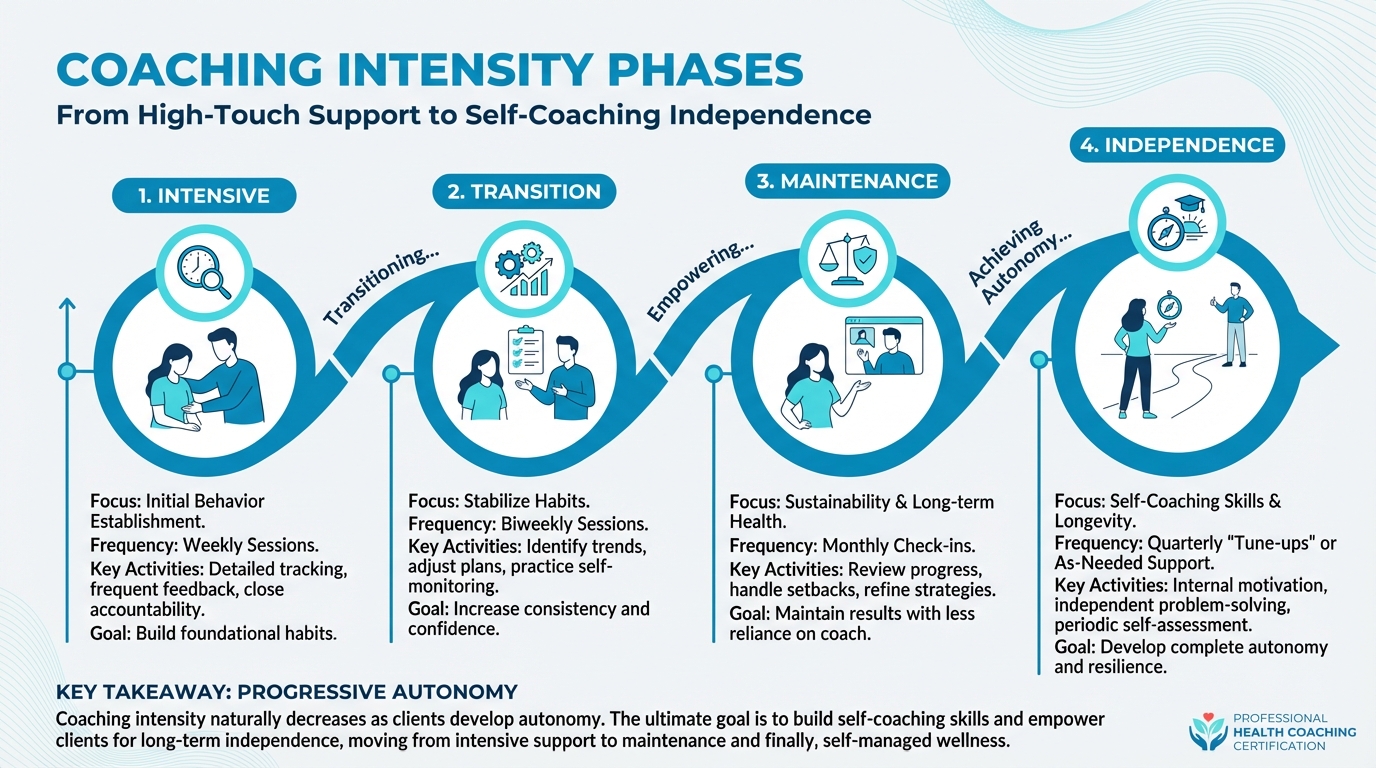
Figure: Intensive → Transition → Maintenance → Independence
Research suggests that ongoing contact supports maintenance, but the nature of that contact can evolve.32 Clients who've developed strong self-regulation skills may need only occasional accountability, while those with complex situations may benefit from longer-term support.
Signs a client is ready for independence
- They can identify their own obstacles before they become problems
- They recover from setbacks without major intervention
- They adapt their behaviors when circumstances change
- They can articulate why they do what they do, not just what to do
- They maintain progress between sessions without significant backsliding
- They express confidence in their ability to continue independently
The independence conversation
Transitioning to independence should be explicit, not assumed. In practice, that often looks like naming what you're seeing, asking what the client wants next, and agreeing on a plan for check-ins.
What not to do
Coach: "You’re doing great. I think you don’t need coaching anymore, so let’s stop meeting."
Client: "Oh… okay."
A better approach
Coach: "I’ve noticed you’re solving problems faster and staying consistent between sessions. How are you feeling about your progress?"
Client: "Honestly, I feel more confident. I don’t panic when things get busy anymore."
Coach: "That’s a big shift. Would you like to move to monthly check-ins for a bit, with the option to book an extra session if something comes up?"
Client: "Yes. That sounds perfect."
[CHONK: Coaching in Practice - The Independence Conversation]
After 18 months of working together, Alex has lost weight, built consistent exercise habits, and maintained these changes through a job transition and a family health crisis. That’s not a small thing, and it’s exactly the kind of real-life stress test that shows whether habits have truly “stuck.”
Coach: "Alex, can we talk about something a little different today? You’ve been incredibly consistent for over a year, you’ve handled setbacks on your own, and you’ve adapted when life got complicated. With all that in mind, I’m wondering if it’s time to shift you into more of a maintenance phase."
Alex: "What does that mean? Are you firing me as a client?"
Coach: laughs "Definitely not. It means I think you’ve built the skills to coach yourself most of the time. Instead of weekly sessions, we could try monthly check-ins. You’d still know I’m here if something comes up, but you wouldn’t need me every single week."
Alex: "Honestly, that sounds right. I feel like I know what to do now, but it’s scary to think about doing it alone."
Coach: "That’s totally normal. And in a way, you’ve been doing it ‘alone’ most of the time anyway. Our sessions are one hour a week, and what happens in the other 167 hours is you practicing these skills in real life. You’ve already proven you can do this. (You don’t have to feel 100 percent ready for it to be the right next step.)"
Alex: "When you put it that way… yeah."
Coach: "How about we test-drive monthly check-ins for three months? If you need more support, we adjust, and if you’re cruising, we might even move to quarterly. The goal is to find the minimum support that keeps you thriving."
Maintenance check-ins versus intensive coaching
Even independent clients often benefit from periodic check-ins, and that’s not a step backward. It’s more like smart upkeep, because these check-ins serve a different purpose than intensive coaching.
Alex: "So what actually changes in maintenance?"
Coach: "The focus shifts. Intensive coaching is about building new habits, and maintenance is about protecting what’s working and catching drift early."
Intensive coaching:
- Weekly sessions focused on active behavior change, with built-in accountability.
- Frequent troubleshooting as new habits take hold.
Maintenance check-ins:
- Monthly to quarterly sessions to review and reinforce what’s already working.
- Early detection of drift, celebration of sustained success, and adjustments as life circumstances change.
Think of maintenance check-ins like dental cleanings: preventive care that catches small issues before they become big problems. A little maintenance beats a full-on repair job.
[CHONK 6: The Practical Toolkit]
Self-monitoring without obsession
Tracking can be genuinely helpful, and it can also become a problem, so the key is matching the approach to the person in front of you.
What not to do
Client: "My HRV is down again. I checked it three times this morning."
Coach: "Then you need to be stricter. If the number is bad, you’re doing something wrong."
A better approach
Client: "My HRV is down again."
Coach: "Let’s zoom out and look at the trend over the last couple of weeks, along with what else is going on in your life. If it’s drifting down, we can treat that as a cue to prioritize recovery, not a grade on you."
Client: "So should I track everything?"
Coach: "Not usually. A good rule is to track just enough to guide decisions, then step back when things are stable."
Principles of healthy self-monitoring:
- Aim to focus on trends, not individual data points. A sleep score of 72 one night means nothing by itself, but a trend of declining sleep scores over two weeks means something.
- Aim to use data to inform decisions, not judge worth. "My HRV is trending down, so I should prioritize recovery" is helpful, while "My HRV is trending down. I'm failing" is not.
- Take periodic breaks by encouraging clients to go tracker-free for a week from time to time. If they can’t tolerate this, that’s useful information worth exploring with care.
- Match tracking intensity to stability by tracking more closely during behavior change phases and keeping it simpler during maintenance.
Research found that self-monitoring was one of the most common and effective behavior change techniques across digital health interventions.33 But the same research noted that most programs lacked components that support long-term maintenance, suggesting that self-monitoring works best as part of a larger system.
Accountability structures that work long-term
Accountability helps, but what “works” long-term depends on the person and the phase they’re in.
What not to do
Coach: "For accountability, text me everything you eat every day. And if you miss a workout, we’ll add another one."
Client: "Honestly, that makes me want to quit."
A better approach
Coach: "When accountability works for you, what does it look like: more frequent check-ins, a shared plan, or a quick weekly review?"
Client: "A weekly review would help. Daily stuff makes me obsessive."
Coach: "Great. Let’s use a lighter structure that supports you now, and we can taper it as things feel steadier."
External accountability (coach/group):
- It’s most helpful during behavior establishment, when routines are still getting built.
- It provides structure when internal motivation wavers and offers troubleshooting in real time.
- If it isn’t tapered over time, it can create dependency.
Social accountability (friends/family):
- It tends to work best when the social network is genuinely supportive.
- It can backfire when network members undermine change, intentionally or not.
- Help clients choose accountability partners carefully, based on actions rather than good intentions.
Self-accountability (internal systems):
- Long-term independence depends on internal systems the client can run without you.
- Those systems are built through self-monitoring, planning, and self-compassion.
- It takes time to develop, but it’s usually the most sustainable option.
Research on smoking cessation found that peers who smoke dramatically increased relapse risk (OR = 8.64), while each additional program session reduced relapse.34 Environment and engagement both matter.
Community and social support
Social support consistently predicts long-term behavior maintenance.8 But not all social support is equal, and “being around people” isn’t always the same as feeling supported.
What not to do
Coach: "You just need better people around you. Join any fitness group and you’ll be fine."
Client: "I’m around people all the time. I still feel alone in this."
A better approach
Coach: "When do you feel most supported right now, even a little? And when do you feel drained or judged?"
Client: "My sister is supportive. Some coworkers… not so much."
Coach: "Let’s build around the people who help, and set some boundaries with the situations that pull you off track."
Helpful support:
- Encouragement without pressure, so the client feels supported rather than policed.
- Practical assistance, like cooking or exercising together, that makes the healthy choice easier.
- Acceptance of setbacks without judgment, which helps clients bounce back faster.
- Modeling healthy behaviors in a way that feels inviting, not performative.
Unhelpful "support":
- Nagging or criticism that triggers defensiveness.
- Competitive comparison that turns change into a status contest.
- Enabling old behaviors, especially during high-stress moments.
- Unsolicited advice that adds noise without adding help.
One particularly poignant finding: among widowed older adults, each point of loneliness predicted an additional decline in physical activity, with the effect being about 150 percent greater than in married or unmarried individuals.35 Social connection isn't just nice, it's a physiological need that affects behavior.
Using wearables wisely
Wearables can be valuable tools. They can also become expensive anxiety-generators for a small subset of clients, so your job is to help people use them in a way that supports well-being.
What not to do
Client: "My sleep score was awful, so I canceled my workout."
Coach: "Good call. Always follow the score."
A better approach
Client: "My sleep score was awful, so I canceled my workout."
Coach: "Let’s use the score as information, not a command. How do you actually feel today, and what would a ‘recovery-friendly’ version of your workout look like?"
Client: "How do I know if this thing is helping or stressing me out?"
Coach: "Look at how you’re using it day to day. Helpful use usually looks like this."
Good use of wearables:
- Noticing trends over time, rather than reacting to any one day.
- Using them to discover patterns, such as "I sleep worse when I drink alcohol."
- Setting gentle reminders to move, especially when sitting time creeps up.
- Celebrating progress in a way that reinforces the habit.
Problematic use of wearables:
- Checking data constantly, especially when anxiety is already high.
- Feeling unable to sleep, exercise, or function without the device.
- Using data to punish oneself instead of course-correcting.
- Prioritizing scores over actual well-being and lived experience.
Remember: approximately 45 percent of wearable users report positive effects on sleep and stress, while only about 4.5 percent report negative effects.22
"Big Rocks First"
This concept comes from time management but applies perfectly to health: Put the big rocks in first, or they won't fit.
What not to do
Client: "I’m sleeping five hours a night, but I’m ready to dial in my cold plunge protocol."
Coach: "Awesome. Let’s optimize the protocol."
A better approach
Client: "I’m sleeping five hours a night, but I’m ready to dial in my cold plunge protocol."
Coach: "We can talk about cold plunges, but sleep is the bigger lever here. What’s one change we could make this week that gets you closer to 7 hours?"
The big rocks for longevity:
1. Sleep, with a realistic goal of 7-9 hours most nights.
2. Movement, building toward 150+ minutes per week that you can repeat.
3. Nutrition, with enough protein and vegetables and portions that make sense for them.
4. Connection, through a few meaningful relationships and regular contact.
5. Stress management, meaning some reliable way to downshift and recover.
The pebbles and sand:
- Specific supplement protocols and stacks, which can help in select cases but rarely beat the basics.
- Precise macronutrient ratios, especially when they don’t change protein, fiber, or overall intake.
- Optimal workout timing, which matters far less than simply training consistently.
- Biohacking techniques, which can be interesting but easy to over-prioritize.
If a client is sleeping poorly but asking about their cold plunge protocol, redirect them. The fundamentals matter more than the optimizations. Always.
Knowing when to stop
Here’s something counterintuitive: good behavior change isn’t only about starting things. Sometimes it’s about stopping things.
Some behaviors are scaffolding, which means they’re useful while someone is building skills, but they’re not meant to stay forever. Other interventions stop working (or never worked in the first place), and some clients collect so many “healthy” practices that the maintenance burden becomes its own problem.
What not to do
Client: "I’m exhausted keeping up with all of this tracking."
Coach: "Then you need to try harder. Consistency means never letting up."
A better approach
Client: "I’m exhausted keeping up with all of this tracking."
Coach: "That makes sense. Let’s sort what’s still helping from what’s become busywork. Sometimes the next step forward is dropping the things you don’t need anymore."
Client: "What kinds of things are okay to stop?"
Coach: "Anything that taught you the skill but is now creating more burden than benefit. For example."
Examples of strategic stopping:
-
Detailed food tracking can be essential during the learning phase but unnecessary (and even counterproductive) once someone has internalized portion awareness. At some point, the client who has been logging meals for six months may benefit from stopping logging and trusting their judgment.
-
Daily weigh-ins might help some people stay aware, but others develop an unhealthy relationship with the scale. In that case, stopping can be the healthier choice.
-
A supplement that made sense based on a blood test might no longer be needed after dietary changes. Stop taking it, retest, and see.
-
A specific workout program served its purpose but is now causing overuse issues or boredom. Time to change or reduce.
-
Tracking sleep scores helped establish better sleep hygiene, but now the client is obsessing over the numbers. Time to take a break.
The question to ask: "Is this still serving you, or are you serving it?"
Permission to stop is often just as valuable as guidance on starting. Clients frequently feel obligated to continue everything they’ve ever started, which can create an unsustainable accumulation of practices. Help them see that letting go of what’s no longer needed is a sign of progress, not failure.
Coaching in Practice: The Quarterly Check-In Template
[CHONK: Coaching in Practice - The Quarterly Check-In Template]
For maintenance-phase clients, a structured quarterly check-in is a simple way to spot drift early, before it turns into relapse. Below is a plug-and-play template you can use, personalize, and revisit each quarter.
What NOT to do (too vague): a check-in that invites a one-word answer
Coach: "So… how’s everything been since we last talked, and has anything new come up?"
Client: "Fine, I guess; nothing really new."
Coach: "Cool, then I’ll let you go and see you next time."
That kind of check-in feels easy, but it also makes it easy to miss early warning signs.
A better approach: a 25-minute quarterly check-in
Part 1: The Big Rocks Review (5 minutes)
Coach: "On a scale of 1-10, how would you rate each of these over the past three months?"
Client: "Okay, sure."
- Sleep quality
- Movement/exercise
- Nutrition
- Social connection
- Stress management
Part 2: What's Working? (5 minutes)
Coach: "What habits or systems have been working well? I want to make sure we don’t accidentally change the stuff that’s keeping you steady, because protecting what’s working is half the battle."
Client: "Yeah, that makes sense."
Part 3: What's Slipping? (5 minutes)
Coach: "Anything that’s started to drift, or feels harder to maintain? We can catch small issues before they become big ones, and if this brings up some guilt or frustration, that’s normal."
Client: "Honestly… yes."
Part 4: Life Changes (5 minutes)
Coach: "Any major changes coming up, like job, family, health, or travel? We can think ahead about how to prepare so the basics don’t get wiped out. Planning beats scrambling."
Client: "I’ve got a lot of travel coming up."
Part 5: Next Quarter Focus (5 minutes)
Coach: "What’s ONE thing you want to focus on improving over the next three months? Keeping it to one is what makes it doable."
Client: "I want to get back to a consistent bedtime."
Key takeaway: This 25-minute structure creates accountability without overwhelming clients. It’s maintenance support, not intensive coaching.
Key takeaways
Supporting behavior change over the long haul comes down to a handful of repeatable principles. You don’t need to memorize these; you just need to recognize them when they show up.
Client: "So what should I expect once the ‘new habit’ phase wears off?"
Coach: "Mostly, the same few patterns show up again and again, and I can give you the quick version of what I watch for if you want."
Client: "Yes, please."
Coach: "Great. Here’s the quick version I watch for."
-
Think in decades, not weeks. Long-term success comes from consistency over intensity, so help clients build sustainable systems rather than relying on heroic short-term efforts.
-
Habits take longer than you think. The median time to habit formation is about two months, not three weeks, which means setting realistic expectations is part of good coaching. That’s good news, because it gives clients permission to stay in the process.
-
Anchor new behaviors to existing routines. Habit stacking, or connecting new behaviors to reliable existing cues, helps accelerate automaticity.
Client: "So it’s less about willpower and more about having a system?"
Coach: "Exactly. And there are a few watch-outs I keep an eye on, too."
-
Watch for wellness perfectionism. Some clients' drive to optimize can turn into counterproductive anxiety, so know the signs and know when to refer.
-
Expect setbacks. Behavior change isn't linear, so help clients distinguish lapses from relapses and respond with compassion and problem-solving.
-
Build toward independence. Your goal is to develop self-coaching skills, not create dependence, and then transition clients to maintenance as they develop autonomy.
-
Fundamentals first. Spoiler: Sleep, movement, nutrition, and connection deliver the vast majority of health benefits, and advanced optimizations matter only after those fundamentals are solid.
Client: "Got it. That’s a helpful checklist."
Coach: "Perfect. We’ll use it to spot drift early and keep your plan simple."
Study Guide Questions
[CHONK: Study guide questions]
Here are a few questions to help you think through the material and prepare for the chapter exam. They're optional, but we recommend you try answering at least a few as part of your active learning process.
-
What is the "adherence paradox," and why does it matter for longevity coaching?
-
According to research, approximately how long does it take to form a health habit? How does this differ from popular beliefs?
-
What is "habit stacking," and how would you explain it to a client?
-
What are three signs that a client's relationship with health tracking might have become problematic?
-
What is the difference between a "lapse" and a "relapse"? Why does this distinction matter?
-
What role should a coach's response play when a client returns after a setback?
-
What are three signs that a client might be ready for independent maintenance rather than intensive coaching?
-
Why is social support important for long-term behavior maintenance? What makes social support helpful versus unhelpful?
[CHONK: Works Cited]
Explore further
Want to explore further? These optional articles cover a few key topics from this chapter in more detail.
- Habit Formation Science: This article covers the 59–66 day timeline and the cue–routine–reward cycle.
- Implementation Science for Longevity Coaches: This article explains why people don’t always do what they know would help, and it offers a systematic way to help them close that gap.
References
These are here in case you want to track down the research later, but you don’t need to read all of them.
-
Roordink EM, Steenhuis IH, Kroeze W, Chinapaw MJ, van Stralen MM. Perspectives of health practitioners and adults who regained weight on predictors of relapse in weight loss maintenance behaviors: a concept mapping study. Health Psychology and Behavioral Medicine. 2021;10(1):22-40. doi:10.1080/21642850.2021.2014332
-
Turkkila E, Pekkala T, Merikallio H, Merikukka M, Heikkilä L, Hukkanen J, et al. Five-year follow-up of a randomized weight loss trial on a digital health behaviour change support system. International Journal of Obesity. 2025;49(5):949-953. doi:10.1038/s41366-025-01742-4
-
Thomas JG, Bond DS, Phelan S, Hill JO, Wing RR. Weight-Loss Maintenance for 10 Years in the National Weight Control Registry. American Journal of Preventive Medicine. 2014;46(1):17-23. doi:10.1016/j.amepre.2013.08.019
-
Ma H, Wang A, Pei R, Piao M. Effects of habit formation interventions on physical activity habit strength: meta-analysis and meta-regression. International Journal of Behavioral Nutrition and Physical Activity. 2023;20(1). doi:10.1186/s12966-023-01493-3
-
Hershfield HE. Future self‐continuity: how conceptions of the future self transform intertemporal choice. Annals of the New York Academy of Sciences. 2011;1235(1):30-43. doi:10.1111/j.1749-6632.2011.06201.x
-
Mitchell NS, Polsky S, Catenacci VA, Furniss AL, Prochazka AV. Up to 7 Years of Sustained Weight Loss for Weight-Loss Program Completers. American Journal of Preventive Medicine. 2015;49(2):248-258. doi:10.1016/j.amepre.2015.02.011
-
Lawlor ER, Hughes CA, Duschinsky R, Pountain GD, Hill AJ, Griffin SJ, et al. Cognitive and behavioural strategies employed to overcome “lapses” and prevent “relapse” among weight‐loss maintainers and regainers: A qualitative study. Clinical Obesity. 2020;10(5). doi:10.1111/cob.12395
-
NIH Office of Behavioral and Social Sciences Research. Promoting the Science and Practice of Health Behavior Maintenance – Workshop 4: Summary. 2024. https://obssr.od.nih.gov/about/health-behavior-maintenance/workshop-4-summary
-
Leung AWY, Chan RSM, Sea MMM, Woo J. An Overview of Factors Associated with Adherence to Lifestyle Modification Programs for Weight Management in Adults. International Journal of Environmental Research and Public Health. 2017;14(8):922. doi:10.3390/ijerph14080922
-
Sawamoto R, Nozaki T, Nishihara T, Furukawa T, Hata T, Komaki G, et al. Predictors of successful long-term weight loss maintenance: a two-year follow-up. BioPsychoSocial Medicine. 2017;11(1). doi:10.1186/s13030-017-0099-3
-
Cheng AL, Dwivedi ME, Martin A, Leslie CG, Fulkerson DE, Bonner KH, et al. Predictors of Progressing Toward Lifestyle Change Among Participants of an Interprofessional Lifestyle Medicine Program. American Journal of Lifestyle Medicine. 2023. doi:10.1177/15598276231222868
-
Singh B, Murphy A, Maher C, Smith AE. Time to Form a Habit: A Systematic Review and Meta-Analysis of Health Behaviour Habit Formation and Its Determinants. Healthcare. 2024;12(23):2488. doi:10.3390/healthcare12232488
-
Stojanovic M, Grund A, Fries S. Context Stability in Habit Building Increases Automaticity and Goal Attainment. Frontiers in Psychology. 2022;13. doi:10.3389/fpsyg.2022.883795
-
Stecher C, Sullivan M, Huberty J. Using Personalized Anchors to Establish Routine Meditation Practice With a Mobile App: Randomized Controlled Trial. JMIR mHealth and uHealth. 2021;9(12):e32794. doi:10.2196/32794
-
Gasana J, O’Keeffe T, Withers TM, Greaves CJ. A systematic review and meta-analysis of the long-term effects of physical activity interventions on objectively measured outcomes. BMC Public Health. 2023;23(1). doi:10.1186/s12889-023-16541-7
-
Baron KG, Abbott S, Jao N, Manalo N, Mullen R. Orthosomnia: Are Some Patients Taking the Quantified Self Too Far?. Journal of Clinical Sleep Medicine. 2017;13(02):351-354. doi:10.5664/jcsm.6472
-
Jahrami H, Trabelsi K, Husain W, Ammar A, BaHammam AS, Pandi-Perumal SR, et al. Prevalence of Orthosomnia in a General Population Sample: A Cross-Sectional Study. Brain Sciences. 2024;14(11):1123. doi:10.3390/brainsci14111123
-
Kozlowska M, Kuty-Pachecka M. When perfectionists adopt health behaviors: perfectionism and self-efficacy as determinants of health behavior, anxiety and depression. Current Issues in Personality Psychology. 2022. doi:10.5114/cipp/156145
-
Pratt VB, Hill AP, Madigan DJ. A longitudinal study of perfectionism and orthorexia in exercisers. Appetite. 2023;183:106455. doi:10.1016/j.appet.2023.106455
-
Bills E, Muir SR, Stackpole R, Egan SJ. Perfectionism and compulsive exercise: a systematic review and preliminary meta-analysis. Eating and Weight Disorders - Studies on Anorexia, Bulimia and Obesity. 2025;30(1). doi:10.1007/s40519-024-01704-1
-
Ryan J, Edney S, Maher C. Anxious or empowered? A cross-sectional study exploring how wearable activity trackers make their owners feel. BMC Psychology. 2019;7(1). doi:10.1186/s40359-019-0315-y
-
Dion K, Porteous M, Kendzerska T, Nixon A, Lee E, de Zambotti M, et al. Sleep, Health Care–Seeking Behaviors, and Perceptions Associated With the Use of Sleep Wearables in Canada: Results From a Nationally Representative Survey. Journal of Medical Internet Research. 2025;27:e68816-e68816. doi:10.2196/68816
-
Österman S, Axelsson E, Forsell E, Svanborg C, Lindefors N, Hedman-Lagerlöf E, et al. Effectiveness and prediction of treatment adherence to guided internet-based cognitive behavioral therapy for health anxiety: A cohort study in routine psychiatric care. Internet Interventions. 2024;38:100780. doi:10.1016/j.invent.2024.100780
-
DiClemente CC, Crisafulli MA. Relapse on the Road to Recovery: Learning the Lessons of Failure on the Way to Successful Behavior Change. Journal of Health Service Psychology. 2022;48(2):59-68. doi:10.1007/s42843-022-00058-5
-
Hayes JF, Wing RR, Unick JL, Ross KM. Behaviors and psychological states associated with transitions from regaining to losing weight. Health Psychology. 2022;41(12):938-945. doi:10.1037/hea0001224
-
MILLER J, NELSON T, BARR-ANDERSON DJ, CHRISTOPH MJ, WINKLER M, NEUMARK-SZTAINER D. Life Events and Longitudinal Effects on Physical Activity: Adolescence to Adulthood. Medicine & Science in Sports & Exercise. 2019;51(4):663-670. doi:10.1249/mss.0000000000001839
-
Verplanken B, Roy D. Empowering interventions to promote sustainable lifestyles: Testing the habit discontinuity hypothesis in a field experiment. Journal of Environmental Psychology. 2016;45:127-134. doi:10.1016/j.jenvp.2015.11.008
-
Yi M, et al.. Transition to retirement impact on health and lifestyle habits: Analysis from a nationwide Italian cohort. BMC Public Health; 2021. https://bmcpublichealth.biomedcentral.com/articles/10.1186/s12889-021-11670-3
-
Pan F, et al.. Understanding the effect of retirement on health behaviors in China: Causality, heterogeneity and time-varying effect. Front Public Health; 2022. https://pmc.ncbi.nlm.nih.gov/articles/PMC9421064/
-
Alonso WW, Kupzyk K, Norman J, Bills SE, Bosak K, Dunn SL, et al. Negative Attitudes, Self-efficacy, and Relapse Management Mediate Long-Term Adherence to Exercise in Patients With Heart Failure. Annals of Behavioral Medicine. 2021;55(10):1031-1041. doi:10.1093/abm/kaab002
-
Schmidt SK, et al.. Maintenance of positive outcomes after lifestyle interventions. Int J Environ Res Public Health; 2020. https://pmc.ncbi.nlm.nih.gov/articles/PMC7602059/
-
Zhu Y, Long Y, Wang H, Lee KP, Zhang L, Wang SJ. Digital Behavior Change Intervention Designs for Habit Formation: Systematic Review. Journal of Medical Internet Research. 2024;26:e54375. doi:10.2196/54375
-
Joo H, Cho MH, Cho Y, Joh H, Kim JW. Predictors of long-term smoking cessation among smokers enrolled in a university smoking cessation program. Medicine. 2020;99(5):e18994. doi:10.1097/md.0000000000018994
-
Pollak C, Verghese J, Blumen HM. Loneliness predicts decreased physical activity in widowed but not married or unmarried individuals. Frontiers in Public Health. 2024;12. doi:10.3389/fpubh.2024.1295128